 EN
EN 中文
中文 ES
ES RU
RU FR
FR PT
PT AR
AR DE
DEPatch-mount weighing for cement and fly ash silos
Batching plants and building material factories often manage several cement or fly ash silos where daily inventory accuracy directly affects purchasing decisions and production scheduling.

Confirm the site problem, the Volivue approach, and the expected operating benefit before final selection.
Manual level checks on tall cement or fly ash silos require climbing, produce only a rough estimate, and leave procurement teams working with stale data that can cause unplanned material shortages.
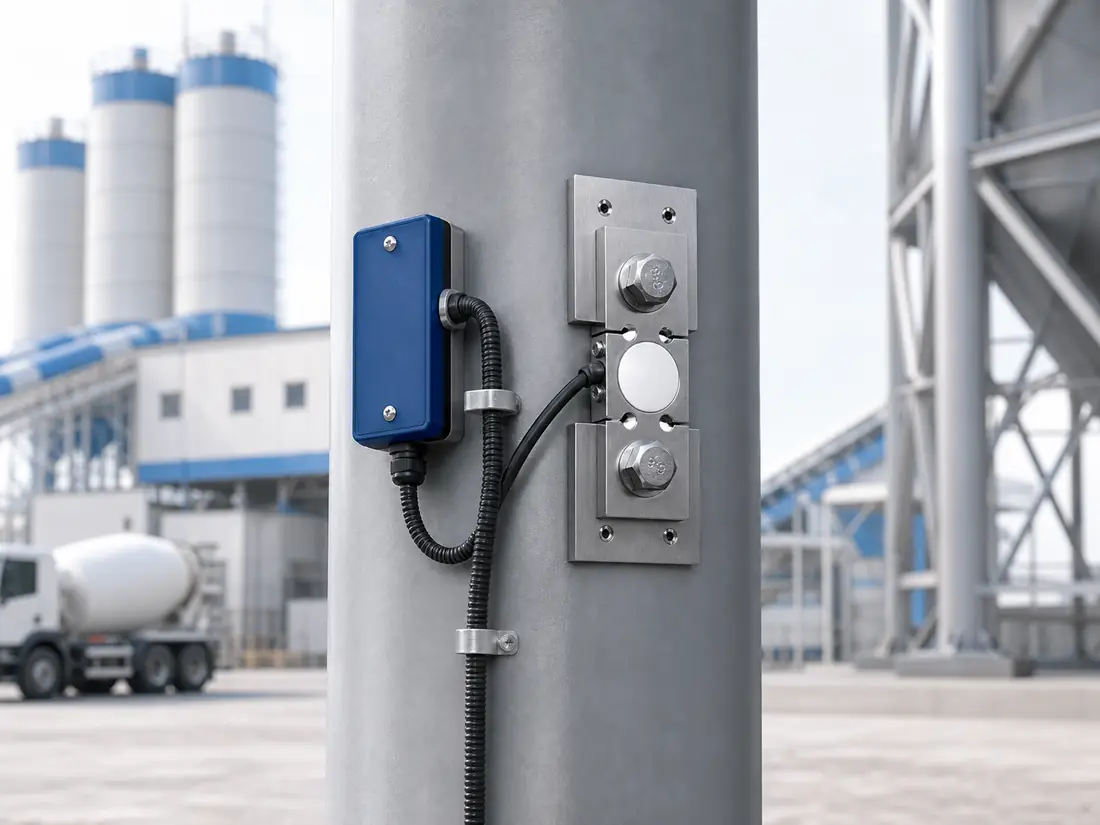
Install external patch-mount strain sensors on silo support legs, connect the controller with built-in 4G or WiFi, and bring real-time weight trends and estimated mass to a multi-silo mobile and desktop dashboard.
Procurement teams work from live inventory trends rather than manual checks, reducing emergency restocking events and improving batch planning accuracy across the plant.
Batching plants, leg-supported silos, and tons that drive purchasing
At batching plants and building material factories, cement and fly ash silos are bought, billed, and planned in tons, yet most sites still estimate stock from hammer taps or climbing checks. The silos themselves are almost always steel structures on support legs, and the dust, buildup, and low-dielectric behaviour that complicate in-silo sensors are irrelevant to a sensing layer that lives entirely outside on the legs.
Patch-mount weighing fits when the silo stands on accessible steel legs and the daily question is remaining tonnage per silo. Where a silo is skirt-supported or sits directly on a foundation with no legs to instrument, a Volivue 80GHz radar on a roof nozzle is the right alternative; plants that need both tonnage and a level profile sometimes deploy the two layers together.

Leg-by-leg sensing into the 4G cloud and the batching PLC
Installation places one strain sensor on each support leg so the controller sees the full load path regardless of leg count, then sums and converts the readings into an estimated silo mass. Calibration uses known events, such as a weighed cement delivery or a metered discharge, and is refined over the first cycles instead of requiring the silo to be emptied.
The controller carries built-in 4G or WiFi, so trends, estimated tonnage, and alarms reach the multi-silo cloud dashboard and mobile app without plant IT work. For automation, 4-20mA or RS485 feeds the batching system directly. A prepared silo is typically instrumented in 2-4 hours, which keeps multi-silo rollouts inside normal maintenance windows.

Four checks before a cement silo weighing rollout
- Leg inventory per silo: count, cross-section, material, and clear access at sensor height, taken from drawings or site photos.
- Capacity confirmed within the 5-3000 ton per silo working range, with the heaviest realistic fill noted.
- Connectivity decided: 4G signal strength at the silo group, or plant WiFi coverage, checked before hardware ships.
- Integration path agreed: cloud dashboard only, or 4-20mA / RS485 into the batching PLC alongside it.
Our silo group mixes three-leg and four-leg silos. How does that affect the layout?
It only changes the sensor count, not the principle: every leg of a silo gets a sensor and the controller is configured per silo, so a three-leg and a four-leg silo can sit side by side on the same dashboard. What matters is that all legs of one silo are instrumented, since a missing leg distorts the load picture.
Will sun on one side of the legs or day-night temperature swings disturb the tonnage trend?
Thermal effects on the legs are part of normal commissioning: sensor placement is symmetric, calibration is verified against known deliveries at different times of day, and the trend view is designed to make real consumption visible above short-term variation. A silo with strong one-sided heating is flagged during the site review rather than discovered later.
Installation requirements and project workflow
Silo structure check
Send clear photos of every support leg, base plate, cross brace, discharge cone, and nearby cable route before quotation.
Mounting position confirmation
Sensors are planned near the lower support-leg area. The surface should be reachable, clean, stable, and suitable for bolted or bonded mounting.
Communication and power review
Sensors, controller, built-in communication settings, software account, and output settings are prepared according to the selected scope.
Factory preparation
Sensors, controller, built-in communication settings, software account, and output settings are prepared according to the selected scope.
Installation and commissioning
A ready silo can typically be installed and brought online in 2-4 hours, depending on access, cabling, signal, and calibration data.
Calibration and remote support
Known refill, discharge, or reference inventory data is used to improve trend calculation; support covers software, alarms, and integration.
Questions before quotation
Does installation require production shutdown?
For many ready sites, basic external sensor installation can be arranged without stopping production. Final scheduling depends on access, cabling, permits, and calibration method.
Does the silo need to be empty?
Usually no. The system is installed outside the silo. Calibration can use known refill, discharge, or reference inventory data.
How many support legs can it work with?
The standard planning range is 2-12 support legs after structure review.
How is the ±0.5-3% FS accuracy achieved?
Accuracy depends on structure condition, sensor placement, stable calibration data, and algorithm setup. The quoted range is a typical planning range after calibration.
Can I view the data on phone and computer?
Yes. The system can provide mobile and desktop monitoring software with real-time level, estimated mass, trend, alarm, and reports.
Can it connect to PLC, ERP, MES, or a custom platform?
Yes. Common outputs include 4-20mA, RS485, and API. Built-in communication and software integration scope are confirmed during project review.
Let us review your silo project.
Send silo type, drawings, material behavior, monitoring points, country or region, and integration target. We will return a practical configuration suggestion and next-step list.