 EN
EN 中文
中文 ES
ES RU
RU FR
FR PT
PT AR
AR DE
DE80GHz radar level for tall, narrow, and wall-buildup silos
Tall and narrow silos for fine powders or granules are prone to material buildup on walls, inlet deposits, and challenging echo conditions because the beam must travel a long distance in a confined space.
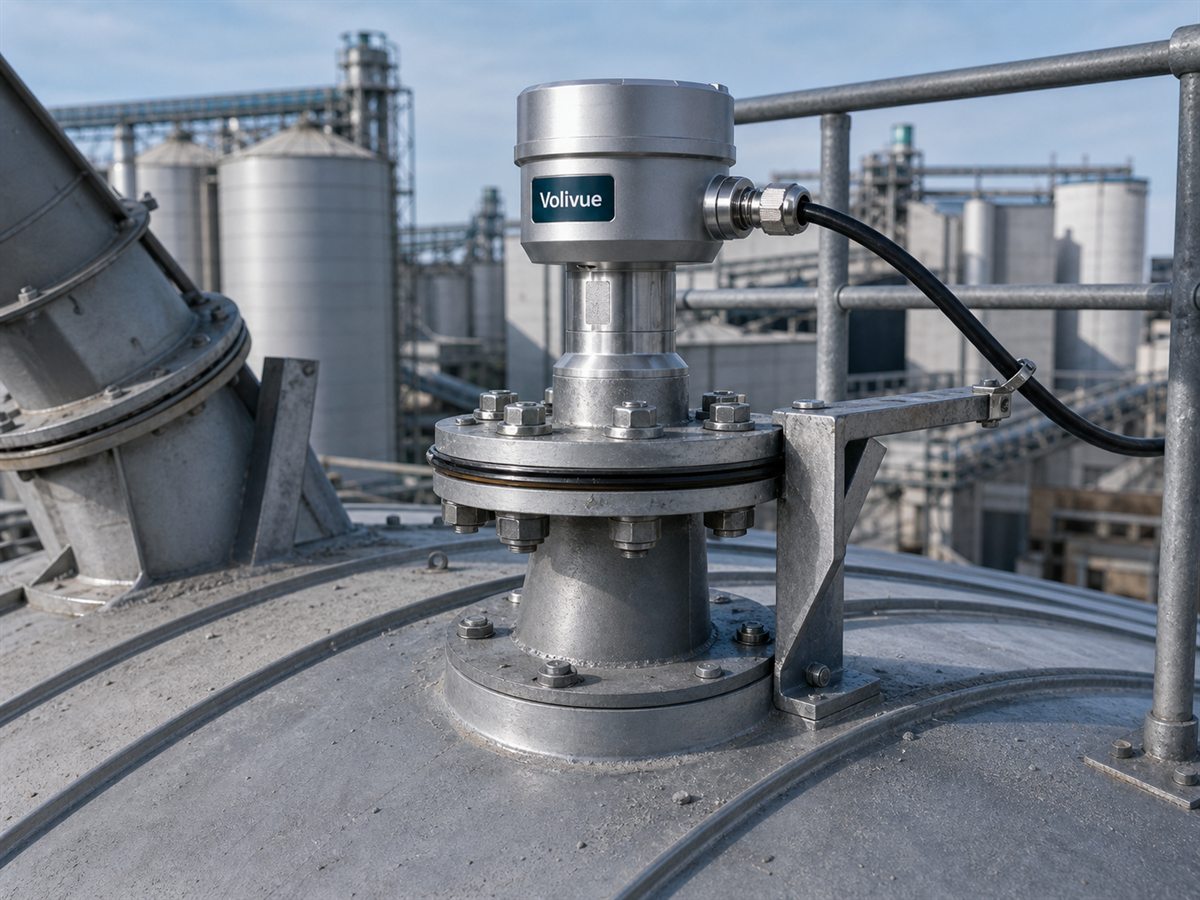
Confirm the site problem, the Volivue approach, and the expected operating benefit before final selection.
Material adhering to silo walls creates false echo sources that shift in position over time, and tall silos with small diameters limit mounting options and increase the risk of the beam path intersecting wall buildup or outlet funnels.
Use a Volivue 80GHz radar with a narrow 3-degree lens antenna to reduce wall interference, center the mounting on the silo top, apply adaptive false echo suppression, and confirm the minimum and maximum measurement range covers the full active silo height.
Level measurement remains stable despite wall adhesion and confined geometry, reducing nuisance alarms and giving operations a reliable level signal across a full production shift.
Long beam paths, close walls, and buildup that keeps moving
Tall, narrow silos force the radar beam to travel a long distance inside a tight cylinder, so even a small beam angle puts energy near the walls at depth. Fine powders make it worse: wall buildup grows, sheds, and regrows, creating false echo sources that change position over weeks, which means a static suppression curve recorded once will slowly stop matching reality.
The Volivue package for this geometry is the 3-degree narrow-beam lens antenna mounted at the silo top center, paired with adaptive false echo suppression that follows slow buildup changes. If no center position can be made available, or internal obstructions dominate the cross-section, a leg-supported silo can switch to the Volivue patch-mount weighing system, where wall buildup simply does not affect the measurement.
Center mounting, blind zone margin, and adaptive suppression
The mounting plan starts with the center: a top-center nozzle keeps the 3-degree beam clear of both walls along the full height. The blind zone below the antenna must stay above the maximum fill line, which on a tall silo usually costs little capacity but must be confirmed against the real fill stop level rather than the drawing.
Adaptive false echo suppression is tuned over the first few fill and discharge cycles so the algorithm learns which reflections belong to the structure and which track product. The output side is conventional, with 4-20mA plus HART or Modbus into PLC and SCADA, and alarm limits are set after the first complete cycles, once the trend has shown the true working range of the silo.
Four checks for tall and narrow silo projects
- Inner diameter and total height measured, with the height-to-diameter ratio checked against the 3-degree beam footprint at the cone.
- Nozzle position assessed for distance from the geometric center, with offsets documented in photos for a beam-path review.
- Buildup history recorded: where deposits form, how thick they get, and how often the silo is cleaned.
- Range and blind zone confirmed so the maximum fill level keeps a safe margin below the antenna reference plane.
Our only available nozzle is off-center, close to the wall. Is the project still feasible?
Often yes, but it needs a review rather than an assumption. With the drawing and the offset distance, the beam path can be checked against wall clearance over the full height; options include a small aiming adjustment, mapping the wall reflection, or fabricating a center nozzle. Tall silos are exactly where guessing is most expensive.
Buildup thickness changes through the year. Will someone need to re-record the false echo map?
Adaptive suppression is designed to track slow changes such as growing or shedding buildup without manual re-mapping. A manual re-map is only worth scheduling after structural changes: new internals, a relocated fill pipe, or a major cleaning that removes thick deposits the algorithm had learned around.
Five checks that decide the radar model, mounting, commissioning, and output scope.
Collect site photos and geometry
Confirm tank or silo height, diameter, roof access, nozzle size, mounting angle, blind zone, and internal obstacles before any range claim.
Review medium and process conditions
Liquid or solid state, dielectric behavior, dust, foam, steam, oil vapor, corrosion, turbulence, agitator, temperature, and pressure determine echo reliability.
Select radar package
Choose range family, antenna or lens, process connection, seal, protection class, cable route, and accessories from the reviewed conditions.
Map usable outputs
Define 4-20mA + HART, optional RS485/Modbus, PLC, dashboard, alarm, trend, or inventory fields so the signal is useful after installation.
Commission and validate
Check scaling, false echo suppression, empty/full references, alarm points, Bluetooth setup, and trend behavior with site data.
Handover and remote support
Confirm documentation, operator training, spare parts, and a remote support path so the team can maintain scaling, echo settings, and integration after commissioning.
Selection questions for engineers, procurement teams, and site maintenance.
Is this an 80GHz radar level transmitter for both liquids and solids?
Yes. The page is positioned for liquid and solid level measurement, including tanks, silos, hoppers, and process vessels after application review.
Does the radar directly measure weight?
No. It measures distance or level. Volume or mass is calculated only when vessel geometry and density assumptions are available.
Can it handle dust, foam, steam, corrosion, and high temperature?
It can be reviewed for these harsh conditions. Suitability depends on medium, temperature, pressure, process connection, echo quality, and selected model.
What does Bluetooth commissioning solve?
Bluetooth commissioning helps review parameters, echo behavior, scaling, and diagnostics more conveniently during setup or maintenance.
Can it connect to PLC or SCADA?
Yes, the project scope can include 4-20mA + HART, optional RS485/Modbus, gateway, dashboard, or API integration.
Do you support hazardous area projects?
We can review hazardous-area requirements, but no ATEX, IECEx, SIL, or local compliance claim is made without verified product data and documentation.
What information should we send first?
Send site photos, nozzle size, medium, temperature, pressure, required output, current measurement method, and drawings if available.
What are the typical lead time and after-sales support?
Lead time depends on model, antenna, process connection, and order quantity, and is confirmed after application review. After-sales support covers documentation, commissioning guidance, spare parts, and remote help.
Send site photos, nozzle, medium, temperature, and output target.
Share tank or silo photos, medium, temperature, nozzle, dust or foam level, internal obstacles, output target, country or region, and drawings if available.