 EN
EN 中文
中文 ES
ES RU
RU FR
FR PT
PT AR
AR DE
DERetrofit patch-mount weighing for existing supported silos
Plants with existing supported silos often need to add inventory monitoring without stopping production, cutting roof openings, emptying the silo, or taking on a full structural weighing project.

Confirm the site problem, the Volivue approach, and the expected operating benefit before final selection.
Traditional load-cell retrofits require lifting the silo, structural modification, or production shutdown, and ultrasonic or radar level sensors need a roof nozzle that many existing silos do not have without costly fabrication.
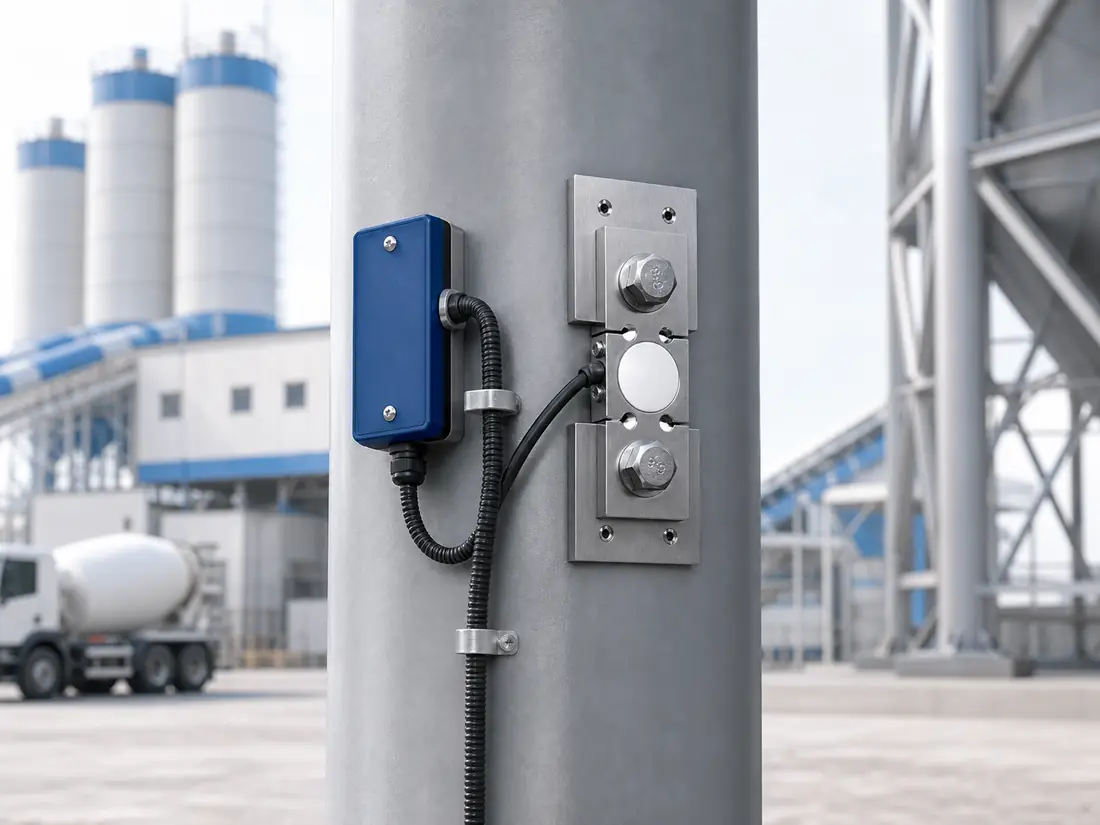
Use patch-mount strain sensors on the existing support legs to retrofit inventory monitoring without structural change, roof work, or silo emptying, then connect to cloud software and existing automation through 4-20mA or RS485.
The plant adds real-time silo inventory to an existing supported silo without production interruption, avoiding structural modification cost and minimizing installation downtime to typically 2-4 hours per silo.
Existing silos, no crane, no roof work, no shutdown
Most inventory projects on existing silos die on the same three rocks: a load-cell retrofit means lifting the silo and modifying the structure, a roof-mounted level sensor needs a nozzle that was never fabricated, and either path seems to require a production stop. The silos most worth instrumenting, the busy and full ones central to daily output, are exactly the hardest to take offline.
Patch-mount weighing was shaped around this constraint: the sensors attach to the existing support legs, so there is no structural modification, no roof opening, and no need to empty the silo. The honest boundary is leg access. Skirt-supported and concrete silos without instrumentable steel legs are not candidates, and there a roof-nozzle radar remains the fallback when an opening exists or can be added.
Survey, mount, calibrate: typically 2-4 hours per silo
A retrofit starts with a short survey: leg sections and surfaces photographed, power and cable routes checked, and the output path into existing automation agreed. On installation day the sensors go onto the legs at the planned positions, the controller is wired and powered, and the silo keeps operating throughout. Typical time on a prepared silo is 2-4 hours.
First readings use the current estimated inventory as a starting baseline, then calibration sharpens with the next known delivery or metered discharge. Outputs are chosen to match the plant: 4-20mA into an existing PLC channel, RS485 onto a bus, or the cloud API where the site prefers dashboards over wiring. Old silos end up reporting like new ones.

Four checks before booking a retrofit crew
- Every leg photographed and measured: cross-section, surface condition, and free working space at the planned sensor height.
- Power confirmed near the silo group, or a supply route planned for the controller.
- Output path agreed with the controls team: spare PLC channel, RS485 bus position, or cloud-only operation.
- Next known delivery or discharge scheduled so calibration can be refined immediately after installation.
Do we have to empty the silo, or at least run it down, before installation?
No. Installation happens at whatever load the silo carries that day. The system records the current state as its baseline and converts it into calibrated tonnage as soon as the next weighed delivery or metered discharge provides a known change. Deliberately running stock down before the crew arrives gains nothing.
Our silos were built in different decades and the leg designs vary. Does that block the retrofit?
Varying leg designs change the survey, not the feasibility: each silo is configured individually for its leg count and section, and sensor positions are set per leg during the site review. What actually disqualifies a silo is having no accessible steel legs at all, which the photo survey establishes before any crew is booked.
Installation requirements and project workflow
Silo structure check
Send clear photos of every support leg, base plate, cross brace, discharge cone, and nearby cable route before quotation.
Mounting position confirmation
Sensors are planned near the lower support-leg area. The surface should be reachable, clean, stable, and suitable for bolted or bonded mounting.
Communication and power review
Sensors, controller, built-in communication settings, software account, and output settings are prepared according to the selected scope.
Factory preparation
Sensors, controller, built-in communication settings, software account, and output settings are prepared according to the selected scope.
Installation and commissioning
A ready silo can typically be installed and brought online in 2-4 hours, depending on access, cabling, signal, and calibration data.
Calibration and remote support
Known refill, discharge, or reference inventory data is used to improve trend calculation; support covers software, alarms, and integration.
Questions before quotation
Does installation require production shutdown?
For many ready sites, basic external sensor installation can be arranged without stopping production. Final scheduling depends on access, cabling, permits, and calibration method.
Does the silo need to be empty?
Usually no. The system is installed outside the silo. Calibration can use known refill, discharge, or reference inventory data.
How many support legs can it work with?
The standard planning range is 2-12 support legs after structure review.
How is the ±0.5-3% FS accuracy achieved?
Accuracy depends on structure condition, sensor placement, stable calibration data, and algorithm setup. The quoted range is a typical planning range after calibration.
Can I view the data on phone and computer?
Yes. The system can provide mobile and desktop monitoring software with real-time level, estimated mass, trend, alarm, and reports.
Can it connect to PLC, ERP, MES, or a custom platform?
Yes. Common outputs include 4-20mA, RS485, and API. Built-in communication and software integration scope are confirmed during project review.
Let us review your silo project.
Send silo type, drawings, material behavior, monitoring points, country or region, and integration target. We will return a practical configuration suggestion and next-step list.