 EN
EN 中文
中文 ES
ES RU
RU FR
FR PT
PT AR
AR DE
DEAufklebe-Wiegung für Zement- und Flugaschesilos
Dosieranlagen und Baustoffwerke verwalten oft mehrere Zement- oder Flugaschesilos, bei denen die tägliche Bestandsgenauigkeit direkt die Einkaufsentscheidungen und die Produktionsplanung beeinflusst.

Prüfen Sie Standortproblem, Volivue-Ansatz und erwarteten betrieblichen Nutzen vor der finalen Auswahl.
Manuelle Füllstandprüfungen an hohen Zement- oder Flugaschesilos erfordern Klettern, liefern nur eine grobe Schätzung und lassen Beschaffungsteams mit veralteten Daten arbeiten, die ungeplante Materialengpässe verursachen können.
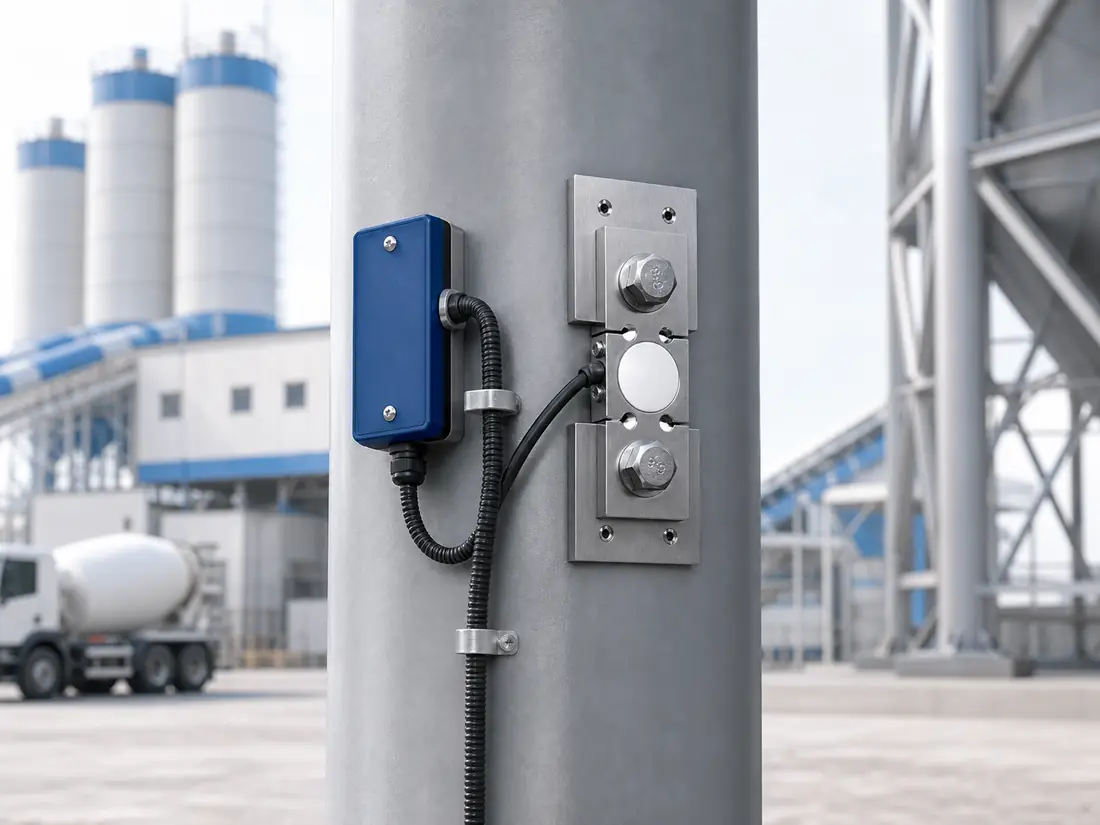
Installieren Sie externe Aufklebe-Dehnungssensoren an den Stützbeinen des Silos, verbinden Sie den Controller mit integriertem 4G oder WiFi und bringen Sie Echtzeit-Gewichtstrends und geschätzte Masse auf ein Multi-Silo-Dashboard für Mobil- und Desktopgeraete.
Beschaffungsteams arbeiten mit Live-Bestandstrends statt mit manuellen Prüfungen, reduzieren Notfallnachbestellungen und verbessern die Genauigkeit der Chargenplanung in der gesamten Anlage.
Batching plants, leg-supported silos, and tons that drive purchasing
At batching plants and building material factories, cement and fly ash silos are bought, billed, and planned in tons, yet most sites still estimate stock from hammer taps or climbing checks. The silos themselves are almost always steel structures on support legs, and the dust, buildup, and low-dielectric behaviour that complicate in-silo sensors are irrelevant to a sensing layer that lives entirely outside on the legs.
Patch-mount weighing fits when the silo stands on accessible steel legs and the daily question is remaining tonnage per silo. Where a silo is skirt-supported or sits directly on a foundation with no legs to instrument, a Volivue 80GHz radar on a roof nozzle is the right alternative; plants that need both tonnage and a level profile sometimes deploy the two layers together.

Leg-by-leg sensing into the 4G cloud and the batching PLC
Installation places one strain sensor on each support leg so the controller sees the full load path regardless of leg count, then sums and converts the readings into an estimated silo mass. Calibration uses known events, such as a weighed cement delivery or a metered discharge, and is refined over the first cycles instead of requiring the silo to be emptied.
The controller carries built-in 4G or WiFi, so trends, estimated tonnage, and alarms reach the multi-silo cloud dashboard and mobile app without plant IT work. For automation, 4-20mA or RS485 feeds the batching system directly. A prepared silo is typically instrumented in 2-4 hours, which keeps multi-silo rollouts inside normal maintenance windows.

Four checks before a cement silo weighing rollout
- Leg inventory per silo: count, cross-section, material, and clear access at sensor height, taken from drawings or site photos.
- Capacity confirmed within the 5-3000 ton per silo working range, with the heaviest realistic fill noted.
- Connectivity decided: 4G signal strength at the silo group, or plant WiFi coverage, checked before hardware ships.
- Integration path agreed: cloud dashboard only, or 4-20mA / RS485 into the batching PLC alongside it.
Our silo group mixes three-leg and four-leg silos. How does that affect the layout?
It only changes the sensor count, not the principle: every leg of a silo gets a sensor and the controller is configured per silo, so a three-leg and a four-leg silo can sit side by side on the same dashboard. What matters is that all legs of one silo are instrumented, since a missing leg distorts the load picture.
Will sun on one side of the legs or day-night temperature swings disturb the tonnage trend?
Thermal effects on the legs are part of normal commissioning: sensor placement is symmetric, calibration is verified against known deliveries at different times of day, and the trend view is designed to make real consumption visible above short-term variation. A silo with strong one-sided heating is flagged during the site review rather than discovered later.
Von Zeichnungen zur Live-Software
Standortprüfung
Zeichnungen, Fotos der Stützen, Material, Kapazität, Kabelweg und Ausgänge senden.
Auswahl und Angebot
Volivue prüft Struktur, Zielgenauigkeit, Kommunikation und Softwareumfang.
Werksvorbereitung
Sensoren, Controller, integrierte Kommunikationseinstellungen, Softwarekonto und Ausgänge werden vorbereitet.
Schnelle Installation
Ein bereites Silo dauert meist 2-4 Stunden je nach Zugang und Kalibrierung.
Kalibrierung und Start
Bekannte Füll-, Entnahme- oder Referenzdaten verbessern die Berechnung.
Remote-Support
Support für Software, Datenprüfung, Alarme und Integration.
Fragen vor dem Angebot
Erfordert die Installation Stillstand?
Bei vielen bereiten Standorten ist externe Installation ohne Produktionsstopp möglich. Zugang, Kabel, Freigaben und Kalibrierung werden geprüft.
Muss das Silo leer sein?
Normalerweise nicht. Das System ist extern und kann bekannte Daten zur Kalibrierung nutzen.
Wie viele Stützen werden unterstützt?
Der Planungsbereich liegt bei 2-12 Stützen nach Strukturprüfung.
Wie wird ±0.5-3% FS erreicht?
Das hängt von Struktur, Sensorposition, Kalibrierdaten und Algorithmus ab.
Sind Daten auf Mobilgerät und PC sichtbar?
Ja, mit Füllstand, geschätzter Masse, Trend, Alarmen und Berichten.
Verbindung zu PLC, ERP, MES oder eigener Software?
Ja. Übliche Ausgänge sind 4-20mA, RS485 und API; integrierte Kommunikation und Softwareumfang werden im Projekt geprüft.
Wir prüfen Ihr Projekt.
Senden Sie Silo- oder Tanktyp, Zeichnungen, Material, Messpunkte, Land oder Region und Ziel-Schnittstelle.