 EN
EN 中文
中文 ES
ES RU
RU FR
FR PT
PT AR
AR DE
DE80GHz-Radar-Füllstand für Flugasche- und Starkstaubsilos
Flugasche und andere ultrafeine Pulver aus Verbrennung oder Industrieprozessen sind extrem leicht, haben niedrige Dielektrizitätskonstanten und erzeugen bei der pneumatischen Befüllung intensive Staubwolken, die viele Sensortypen überfordern.
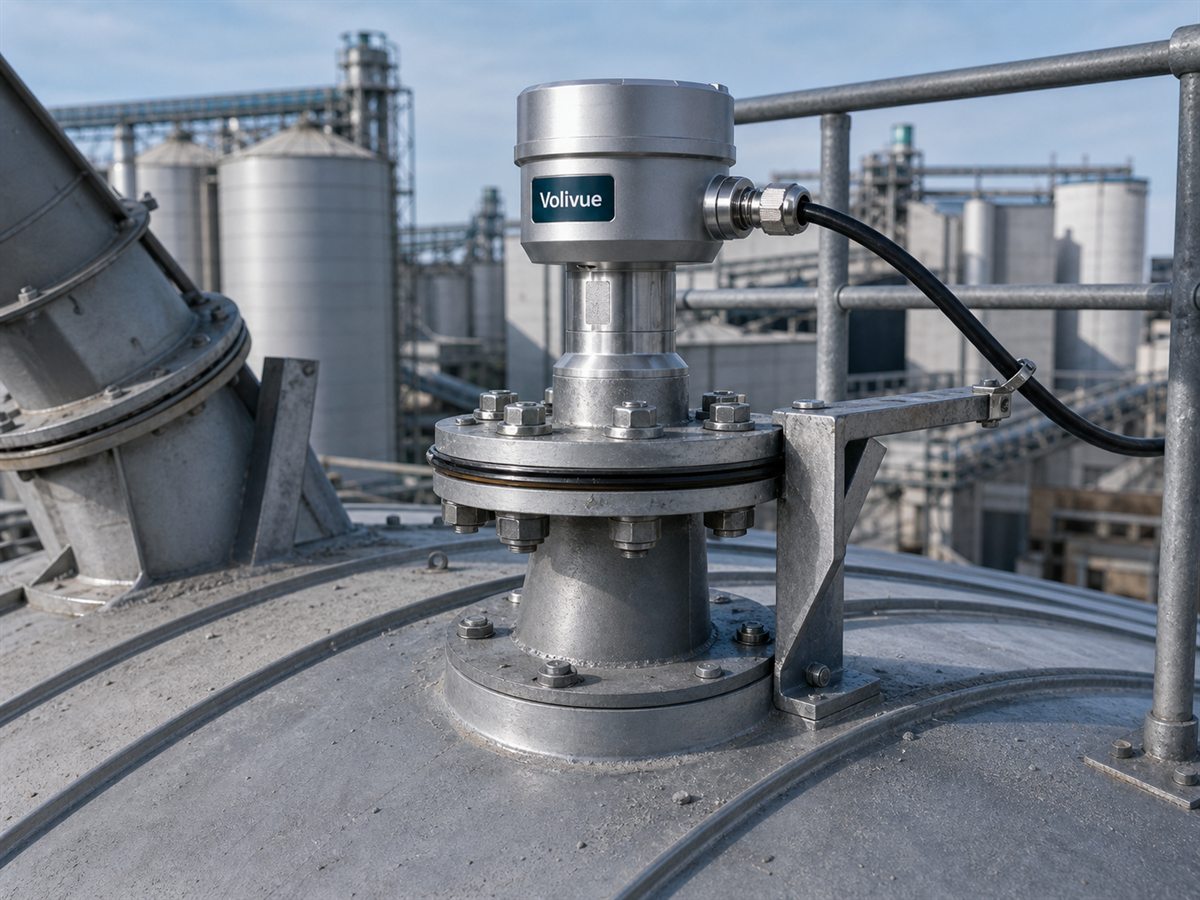
Prüfen Sie Standortproblem, Volivue-Ansatz und erwarteten betrieblichen Nutzen vor der finalen Auswahl.
Flugasche hat eine niedrige Dielektrizitätskonstante und ultrafeine Partikelgröße, sodass Kontaktsensoren, Ultraschallsensoren und niederfrequente Radargeraete in aktiven Flugaschesilos oft schwache, unstete Echos oder häufige Fehlfüllstandwerte liefern.
Setzen Sie einen Volivue-80GHz-FMCW-Radartransmitter mit großer Linsenantenne ein, wählen Sie einen geeigneten Stutzenabstand, um die schlimmste Staubzone zu meiden, konfigurieren Sie die Leerecho-Unterdrueckung und prüfen Sie Strahlwinkel und Empfindlichkeit für die jeweilige Flugaschedichte und den Füllzyklus.
Zuverlässige Füllstandwerte werden auch während und nach der pneumatischen Befüllung beibehalten, sodass die Anlage den Silobestand ohne manuelle Inspektion oder häufige Neukalibrierung verfolgen kann.
Low-dielectric fly ash and the worst dust an instrument will meet
Fly ash combines nearly every difficulty a non-contact sensor can face: ultra-fine particles, very low bulk density, a low dielectric constant that returns weak echoes, and pneumatic filling that turns the whole headspace into a dust cloud for minutes at a time. Ultrasonic devices and lower-frequency radars frequently lose track in these silos, which is why fly ash is treated as its own selection case.
The Volivue answer is an 80GHz transmitter with a large lens antenna and enough nozzle standoff to clear the densest dust zone above the fill point. If the fly ash silo stands on steel support legs and the commercial question is tons on hand rather than a level profile, the Volivue patch-mount weighing system is worth comparing before a roof nozzle is fabricated.
Standoff, suppression, and proving the loop on a real fill
Deployment hinges on placement: the nozzle should sit away from the pneumatic inlet so the beam does not stare into the incoming jet, and the standoff is set so the antenna face stays above the worst dust band. Empty-silo echo suppression is recorded before first filling, and sensitivity is reviewed against the actual ash density rather than catalogue defaults.
On the signal side the transmitter offers 4-20mA with HART for a direct loop into the plant DCS or PLC, with Modbus as the multi-silo option. Commissioning should deliberately span one full pneumatic fill so filter behaviour, alarm thresholds, and the recovery time after the dust peak are all verified on record before the loop is handed to operations.
Four checks for a fly ash silo level project
- Fill path documented: pneumatic line entry point, fill rate, and the spacing between the inlet and every candidate mounting nozzle.
- Material data gathered: ash source, bulk density range, and any known tendency to bridge or compact in the cone.
- Commissioning window planned to include at least one complete pneumatic fill and the settling period that follows it.
- Interface and cable route fixed: 4-20mA + HART or Modbus, gland sizes, and the distance to the nearest marshalling cabinet.
The echo is already weak when the silo is nearly empty. Is that normal for fly ash?
Yes. A long measuring distance plus a low dielectric constant gives the weakest echo of the whole cycle at low level. The large lens antenna and empty echo suppression exist exactly for this point; if low-level readings stay unstable after tuning, the nozzle position and standoff should be reviewed rather than the gain pushed further.
Does ash coating on the antenna mean we need a scheduled cleaning routine?
The lens geometry sheds most loose dust, and a correct standoff keeps the antenna face out of the densest zone, so many sites only inspect the antenna during routine silo checks. If a site does see hard coating, that is usually a placement signal: review the nozzle position and fill-jet direction before adding cleaning hardware.
Fünf Prüfungen bestimmen Modell, Montage, Inbetriebnahme und Ausgänge.
Fotos und Geometrie sammeln
Höhe, Durchmesser, Zugang, Stutzen, Winkel, Totzone und interne Hindernisse bestätigen.
Medium und Prozess prüfen
Flüssig/fest, Dielektrikum, Staub, Schaum, Dampf, Korrosion, Turbulenz, Rührwerk, Temperatur und Druck bestimmen das Echo.
Radar-Paket wählen
Messbereich, Antenne oder Linse, Anschluss, Dichtung, Schutzart, Kabel und Zubehör wählen.
Nutzbare Ausgänge abbilden
4-20mA + HART, RS485/Modbus, PLC, Dashboard, Alarme, Trend oder Bestand definieren.
Inbetriebnehmen und validieren
Skalierung, Störechos, Leer-/Vollreferenzen, Alarme, Bluetooth und Trend mit Standortdaten prüfen.
Übergabe und Remote-Support
Dokumentation, Bedienerschulung, Ersatzteile und einen Remote-Support-Weg bestätigen, um Skalierung, Echo-Einstellungen und Integration nach der Inbetriebnahme zu pflegen.
Fragen gegen falsche Auswahl und falsche SEO-Erwartungen.
Geeignet für Flüssigkeiten und Schüttgüter?
Ja, für Tanks, Silos, Trichter und Behälter nach Anwendungsprüfung.
Misst es Gewicht direkt?
Nein. Es misst Distanz oder Füllstand; Volumen oder Masse benötigen Geometrie und Dichte.
Staub, Schaum, Dampf, Korrosion und hohe Temperatur?
Diese Bedingungen können geprüft werden; Eignung hängt von Medium, Temperatur, Druck, Anschluss, Echo und Modell ab.
Wozu Bluetooth?
Zur Prüfung von Parametern, Echo, Skalierung und Diagnose bei Inbetriebnahme oder Wartung.
PLC oder SCADA?
Ja, mit 4-20mA + HART, optional RS485/Modbus, Gateway, Dashboard oder API je nach Projekt.
Ex-Bereiche?
Anforderungen können geprüft werden, aber keine ATEX-, IECEx-, SIL- oder lokale Zusage ohne Dokumente.
Was zuerst senden?
Fotos, Stutzen, Medium, Temperatur, Druck, gewünschter Ausgang, aktuelle Methode und Zeichnungen.
Wie sind typische Lieferzeit und After-Sales-Support?
Die Lieferzeit hängt von Modell, Antenne, Prozessanschluss und Menge ab und wird nach der Anwendungsprüfung bestätigt. Der After-Sales-Support umfasst Dokumentation, Inbetriebnahmehilfe, Ersatzteile und Remote-Unterstützung.
Senden Sie Fotos, Stutzen, Medium, Temperatur und Zielausgang.
Teilen Sie Fotos, Medium, Temperatur, Stutzen, Staub oder Schaum, Hindernisse, Ausgang, Land und Zeichnungen.