 EN
EN 中文
中文 ES
ES RU
RU FR
FR PT
PT AR
AR DE
DEAufklebe-Wiegung für Kunststoffpellet- und Pulversilos
Hersteller von Kunststoffpellets und Polymerpulver benötigen die Anbindung des Silobestands an Produktionsplanungs-, Einkaufs- und Lagerberichtssysteme mit minimaler Ausfallzeit während der Installation.

Prüfen Sie Standortproblem, Volivue-Ansatz und erwarteten betrieblichen Nutzen vor der finalen Auswahl.
Punktfüllstandschalter und manuelle Prüfungen können nicht den kontinuierlichen Bestandstrend liefern, den die Produktionsplanung benötigt, und dachmontierte Füllstandsensoren erfordern Silozugang und können mit niederdielektrischen Kunststoffmaterialien Schwierigkeiten haben.
Verwenden Sie externe Aufklebe-Dehnungssensoren an den Stützbeinen, um die geschätzte Silomasse kontinuierlich zu verfolgen, und nutzen Sie den API- oder RS485-Ausgang, um Bestandsdaten direkt in ERP, MES oder Produktionsplanungssoftware zu übertragen.
Produktions- und Beschaffungsteams sehen den Live-Silobestand in ihrer Planungssoftware, reduzieren kurzfristige Materialengpässe und ermöglichen eine genauere Produktionschargenplanung.
Silo farms that report to ERP, not to a local display
Compounding and polymer plants typically run rows of pellet and powder silos whose inventory matters less on a local display than inside ERP, MES, and production planning. Point-level switches only say full or empty, manual rounds produce stale spreadsheets, and roof-mounted level sensors need silo access while sometimes struggling at long range on low-dielectric plastic materials.
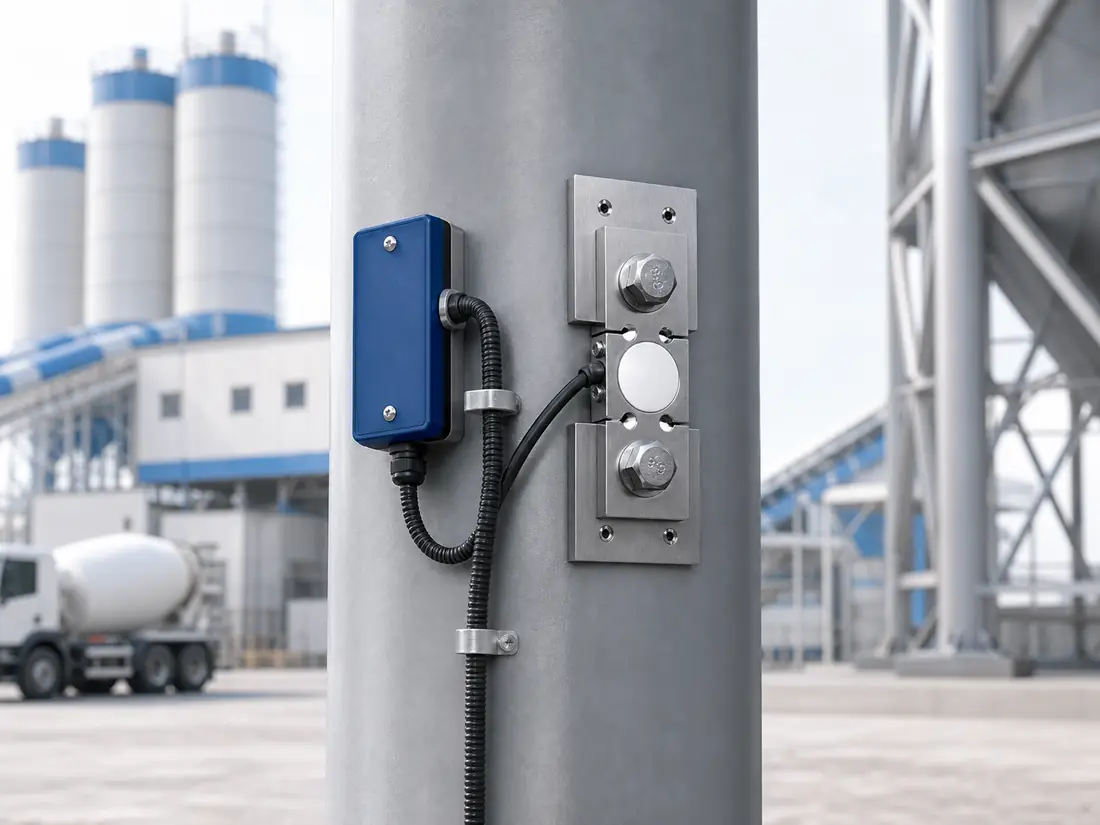
Patch-mount weighing sidesteps the material physics entirely: strain sensors on the support legs track mass, so pellet shape, dielectric constant, and surface angle play no role. The fit requires leg-supported silos; where a silo lacks accessible legs, or a process genuinely needs the level surface rather than tonnage, a Volivue 80GHz radar with false echo mapping covers that case.
API and RS485 routes into ERP, MES, and planning software
Integration is decided before hardware ships: the cloud API pushes per-silo mass, trend, and alarm data to ERP or MES on the IT side, while RS485 serves PLC-centred plants that poll values locally. Each silo ID is mapped to a material code, so planners see resin grades and quantities rather than bare sensor channels.
Rollout across a silo farm proceeds silo by silo without stopping production, since all work is external. A practical sequence instruments one pilot group first, validates calibration against known deliveries and consumption, then extends the same template of sensor layout, addressing, and ERP mapping to the remaining rows on a fixed schedule.
Four checks before connecting pellet silos to ERP
- Per-silo structural sheet: leg count, capacity, and access, compiled for the whole farm before sequencing the rollout.
- Integration route chosen: cloud API into ERP / MES, local RS485 polling, or both in parallel.
- Silo-to-material mapping table prepared so every silo ID carries its resin or powder grade in the planning system.
- Calibration plan written around known events: weighed incoming deliveries or metered extruder consumption.
How is the system calibrated if we can never empty the silos?
Calibration works on deltas, not on an empty reference: a weighed delivery or a metered consumption gives a known mass change that the controller matches against the leg readings. Accuracy then tightens over the first few normal cycles, all while the silo keeps feeding production.
Can the inventory land in our ERP without anyone exporting files?
Yes, that is the intended mode. The cloud API delivers silo mass and trend data to the ERP or MES endpoint directly, or a PLC gateway forwards RS485 values into the plant historian. Once the silo-to-material mapping is configured, planners work from live figures with no manual step in between.
Von Zeichnungen zur Live-Software
Standortprüfung
Zeichnungen, Fotos der Stützen, Material, Kapazität, Kabelweg und Ausgänge senden.
Auswahl und Angebot
Volivue prüft Struktur, Zielgenauigkeit, Kommunikation und Softwareumfang.
Werksvorbereitung
Sensoren, Controller, integrierte Kommunikationseinstellungen, Softwarekonto und Ausgänge werden vorbereitet.
Schnelle Installation
Ein bereites Silo dauert meist 2-4 Stunden je nach Zugang und Kalibrierung.
Kalibrierung und Start
Bekannte Füll-, Entnahme- oder Referenzdaten verbessern die Berechnung.
Remote-Support
Support für Software, Datenprüfung, Alarme und Integration.
Fragen vor dem Angebot
Erfordert die Installation Stillstand?
Bei vielen bereiten Standorten ist externe Installation ohne Produktionsstopp möglich. Zugang, Kabel, Freigaben und Kalibrierung werden geprüft.
Muss das Silo leer sein?
Normalerweise nicht. Das System ist extern und kann bekannte Daten zur Kalibrierung nutzen.
Wie viele Stützen werden unterstützt?
Der Planungsbereich liegt bei 2-12 Stützen nach Strukturprüfung.
Wie wird ±0.5-3% FS erreicht?
Das hängt von Struktur, Sensorposition, Kalibrierdaten und Algorithmus ab.
Sind Daten auf Mobilgerät und PC sichtbar?
Ja, mit Füllstand, geschätzter Masse, Trend, Alarmen und Berichten.
Verbindung zu PLC, ERP, MES oder eigener Software?
Ja. Übliche Ausgänge sind 4-20mA, RS485 und API; integrierte Kommunikation und Softwareumfang werden im Projekt geprüft.
Wir prüfen Ihr Projekt.
Senden Sie Silo- oder Tanktyp, Zeichnungen, Material, Messpunkte, Land oder Region und Ziel-Schnittstelle.