 EN
EN 中文
中文 ES
ES RU
RU FR
FR PT
PT AR
AR DE
DEHow Strain Gauge Silo Weighing Works and What Determines Its Accuracy

Strain gauge silo weighing infers the mass of material inside a silo by measuring how much the support legs deform under load. Instead of sensors that look at the surface of the material from above, the technique reads the structure itself: as product accumulates, each leg carries more weight, compresses by a few microns, and that minute deformation is converted into a mass reading. For operators running existing leg-supported silos, this is attractive because the measurement is patch-mounted onto the legs without cutting into the silo, opening the roof, or stopping production. This article explains the physics, then walks through the factors that decide whether you land near ±0.5% or closer to ±3% of full scale.
The physics: from microstrain to mass
Every load-bearing leg is, in engineering terms, a column under compression. When you add material to the silo, the extra force shortens each leg by an extremely small amount — typically on the order of microns over a structural member that may be several meters long. The relative change in length is called strain, and for steel it is tiny: a heavily loaded member might see only a few hundred microstrain (parts per million of its length).
A strain gauge is a thin foil grid bonded to the surface of the leg. When the leg deforms, the foil deforms with it, and the electrical resistance of the grid changes in proportion to the strain. That resistance change is wired into a Wheatstone bridge, which turns a fractional resistance change into a measurable voltage. Amplify and digitize that voltage and you have a signal that tracks the load in the leg.
The key chain is therefore:
- Material mass adds force to the silo structure.
- Force is distributed across the support legs.
- Each leg strains in proportion to the force it carries.
- The gauge converts strain to an electrical signal.
- The system sums the legs and converts force back to mass.
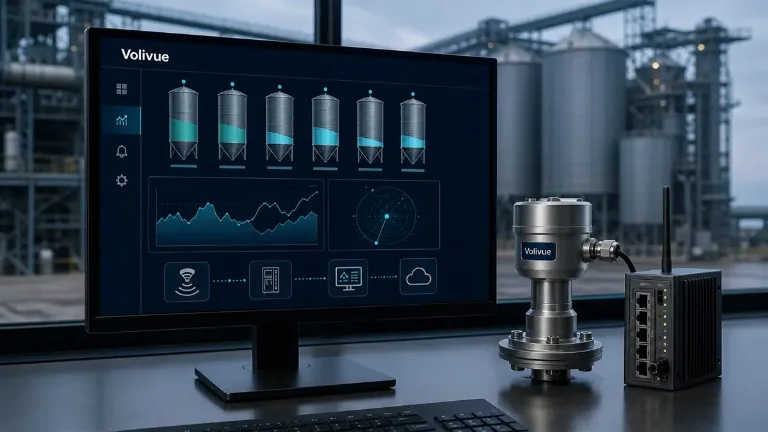
The patch-mount silo weighing system (Volivue Patch-Mount Silo Weighing System) externalizes this measurement: the gauges are bonded to the outside of the existing legs rather than building load cells into the foundation. That is what makes it the first-choice retrofit for silos that were never designed with weighing in mind.
Why leg load reflects material mass

The reason this works is conservation of force. The total downward force at the supports equals the weight of the silo shell, its fittings, and everything inside it. The shell and fittings are a fixed tare; once that baseline is established, any change in total leg load corresponds to a change in stored material.
This has a practical consequence worth stating plainly: the system measures load, and load is converted to mass. It does not see the material directly, so it is indifferent to the product’s surface profile, dielectric constant, dust, or color. A silo that holds cement, fly ash, lime, mineral powder, plastic pellets, grain, feed, or food ingredients all looks the same to the legs — they only feel weight. That is a genuine advantage over level-based methods when material bridges, rat-holes, or forms an irregular cone, because volume-to-mass conversion errors from an uneven surface simply don’t apply.
It is also why this approach pairs well with, rather than replaces, top-down level instruments. A non-contact 80 GHz radar level sensor (Volivue 80 GHz radar) tells you where the surface is; leg weighing tells you how much mass is actually present. Many plants run both for cross-checking.
What determines accuracy

Volivue’s patch-mount system delivers accuracy of typically ±0.5–3% of full scale after on-site calibration, with capacities typically 5–3000 t depending on the structure and the number of legs (2–12 legs, subject to structural review). Where a given installation lands inside that band is decided by a handful of physical and procedural factors.
Number of legs and load symmetry
Material rarely loads a silo perfectly evenly. Inlet position, discharge geometry, and flow behavior all shift the center of mass, so individual legs can carry unequal shares of the total. The defense is to instrument enough legs and read them symmetrically: the more legs you measure, the better the system averages out an off-center load. Measuring only a subset, or a structure with very asymmetric leg loading, widens the error band. This is one reason leg count and configuration require a structural review before commissioning rather than a generic specification.
Temperature
Steel expands and contracts with temperature, and that thermal strain looks, electrically, much like load strain. A leg warmed by midday sun on one side of the silo will report differently from a shaded leg if temperature is not handled. The system addresses this with bridge configurations and compensation, and Volivue’s signal chain adds AI-based algorithms and filtering to model and suppress thermal drift and other slow disturbances. Sites with large diurnal swings or one-sided solar exposure benefit most from this compensation.
Wind and dynamic loads
Wind load, vibration from nearby equipment, and the impact of material during fast filling all add force that is not stored mass. These show up as noise or transient spikes on the raw signal. Filtering and trend-based calculation separate the genuine inventory trend from short-lived disturbances, which is why a stable trend reading is more trustworthy than any single instantaneous sample during a windstorm or an aggressive fill.
Installation quality
Because the sensor reads microstrain, the bond between gauge and leg is critical. Poor surface preparation, an inconsistent adhesive line, or a gauge placed on a local stiffener or weld where strain is distorted will all degrade repeatability. Proper placement on a clean, representative section of each leg is what makes the reading proportional to true load. Installation is typically 2–4 hours per leg when conditions allow, and that time is mostly careful surface prep and placement — not something to rush.
On-site calibration
The factory cannot know your exact silo geometry, tare weight, or load distribution, so the published accuracy is explicitly after on-site calibration. Calibration anchors the system to known reference points — for example, a verified empty (tare) condition and one or more known added quantities — so the conversion from electrical signal to mass matches reality. An uncalibrated installation can still show useful trends, but the absolute accuracy figure only applies once calibration is done.
Structural review
Finally, the structure itself sets the ceiling on achievable accuracy. Leg stiffness, foundation behavior, bracing, and how cleanly load transfers into the legs all influence how faithfully strain represents stored mass. The structural review before installation isn’t a formality; it determines realistic leg count, expected symmetry, and therefore which end of the ±0.5–3% band is attainable.
Reaching and holding accuracy over time

Hitting the target accuracy is a commissioning task; keeping it is an operational one.
| Phase | What governs accuracy | Practical action |
|---|---|---|
| Design | Structure, leg count, symmetry | Structural review; instrument enough legs |
| Install | Bond quality, gauge placement | Clean prep, representative leg sections |
| Commission | Reference points | On-site calibration to tare and known loads |
| Operate | Drift, environment | Trend monitoring, periodic re-checks |
Over the long term, three habits preserve accuracy. First, re-verify the tare periodically; a confirmed empty silo is the cheapest recalibration reference you have. Second, watch the trend rather than chasing single readings — the AI filtering is designed to give a stable inventory trend, and a drift in that trend over weeks is a clearer signal of a real change than minute-to-minute noise. Third, keep the data flowing into systems that can act on it. The system outputs over 4–20 mA, RS485 (Modbus), or an API, with 4G, WiFi, or Bluetooth connectivity, and an enclosure rated IP66 (planned), so readings can feed inventory planning, production scheduling, and automation without manual gauging.
Used this way, strain gauge silo weighing turns a structure you already own into a continuous inventory instrument: no roof penetration, no production stoppage, and an accuracy figure you can defend because you know exactly which factors set it.
If you want a structural review and a realistic accuracy estimate for your specific silos, talk to a Volivue weighing engineer.
Related reading
For help choosing between leg-based weighing and top-down level measurement — and when to run both together — see our Technical Insights for technology comparison guides.