 EN
EN 中文
中文 ES
ES RU
RU FR
FR PT
PT AR
AR DE
DEFly Ash Level Measurement in Coal-Fired Power Plant Silos
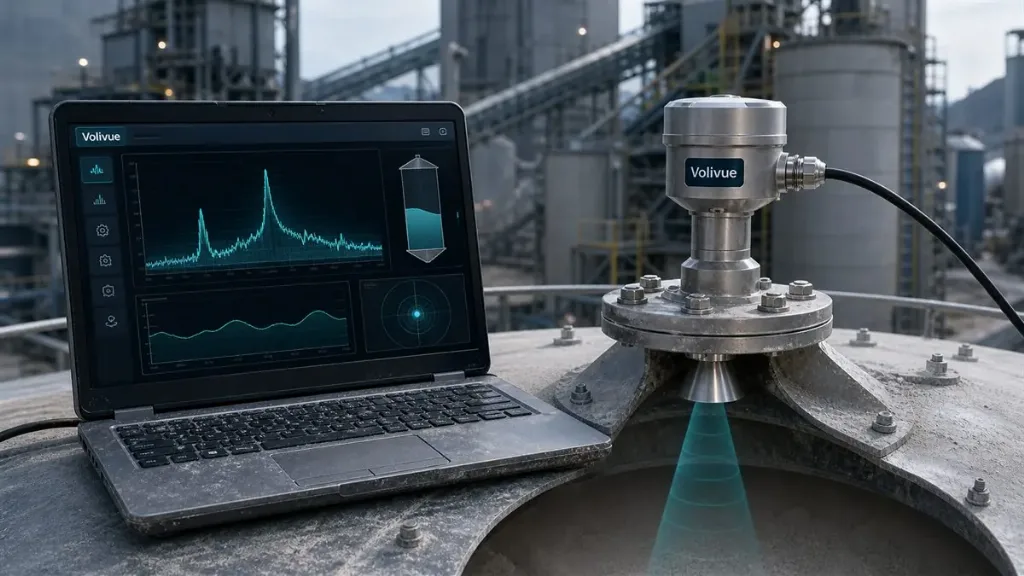
Coal-fired power plants generate enormous volumes of fly ash, and every tonne of it has to be captured, conveyed, and stored before it leaves the site as a byproduct or waste stream. The silos that hold that material sit at the center of plant operations, yet they are among the hardest vessels to instrument. Accurate fly ash level measurement is what keeps those silos from overfilling, running empty, or forcing operators onto a rooftop with a weighted tape. In this article we look at why fly ash is such a difficult material to gauge, why 80GHz non-contact radar is well suited to the duty, and how continuous level monitoring improves both safety and day-to-day plant operation.
Why Fly Ash Is a Hard Material to Gauge
Fly ash is one of the more demanding bulk solids a level instrument will ever face. It is extremely fine, often in the single-digit to tens-of-microns range, which means it behaves more like a fluidized powder than a granular solid. When ash is pneumatically loaded into a silo, the headspace fills with a dense, swirling dust cloud that can persist for several minutes after loading stops. Any sensing technology that depends on a clear line of sight, an optical path, or a clean signal return will struggle in that environment.
The material is also electrically challenging. Fly ash has a low dielectric constant, which weakens the energy reflected back to a radar sensor. A weak echo against a noisy, dust-laden background is exactly the condition where lower-frequency or poorly focused instruments lose the surface and report a false level. On top of that, the ash surface is rarely flat. Pneumatic filling builds cones and ridges, and withdrawal through the silo cone creates rat-holes and uneven drawdown, so the instrument has to interpret an irregular, moving surface rather than a calm liquid level.
Finally, the storage conditions themselves are abrasive and warm. Ash can arrive hot from the precipitators or baghouse, the silo walls accumulate buildup, and the constant flow of dry powder is hard on any component that contacts the material. These combined factors are why many plants have historically relied on point switches, manual sounding, or load-cell estimates rather than a true continuous level reading.
The Operational Cost of Poor Level Data
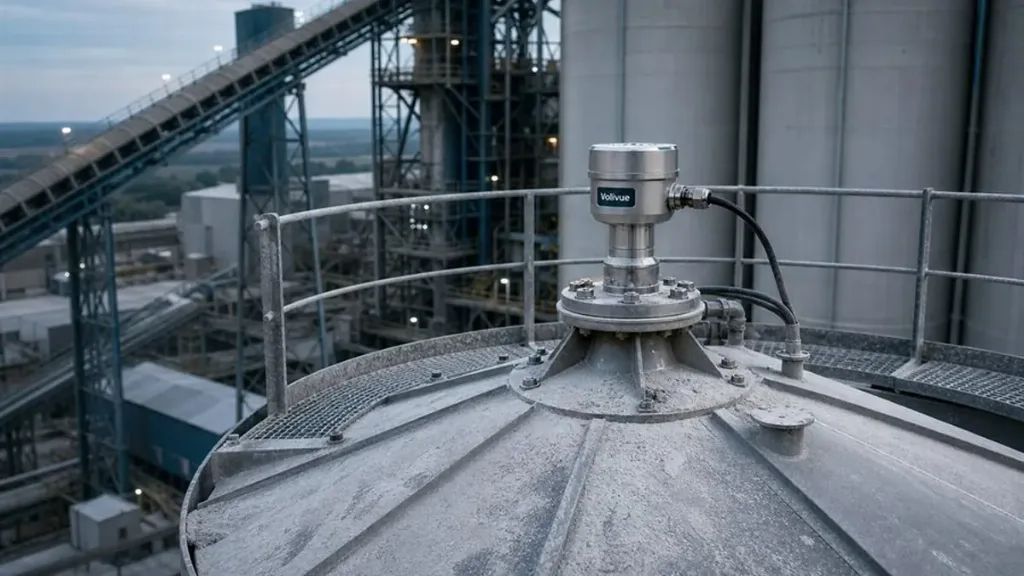
When level data is unreliable, the consequences ripple through the whole ash handling system. An overfilled silo can blind the loading line, plug the filter vent, and in the worst case lift the roof or rupture a vent during a pressurized fill. An apparently empty silo that still holds bridged material can stall a discharge truck and idle a transport crew. Operators who cannot trust the gauge fall back on climbing the silo to drop a tape, a task that exposes people to working at height, confined-space hazards, and respirable dust.
Inaccurate readings also undermine inventory and dispatch planning. Power plants increasingly treat fly ash as a saleable product for cement and concrete production, and buyers expect predictable availability. Without dependable fly ash level measurement, the dispatch desk is guessing at how many trucks can be filled, and the plant either holds excess inventory or scrambles to find storage when production outpaces removal. Reliable, continuous level data turns the silo from a black box into a planned, schedulable asset.
Why 80GHz Radar Fits the Duty
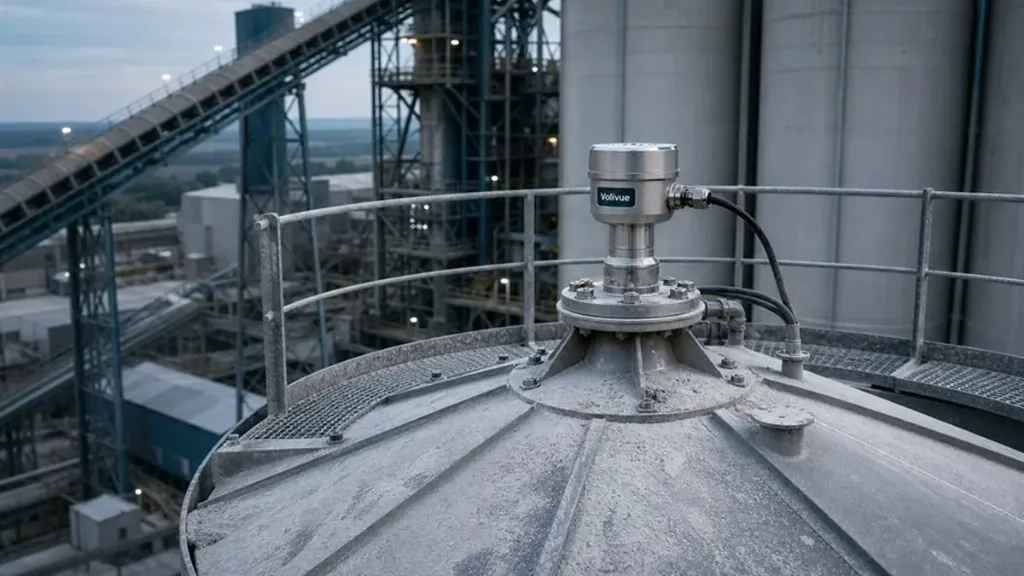
A non-contact 80GHz FMCW radar level system is purpose-built for exactly the conditions a fly ash silo presents. The defining advantage of operating at 80GHz is the narrow beam angle. A high-frequency radar focuses its energy into a tight cone, which lets the signal travel down the silo without striking ladders, fill pipes, internal structures, or wall buildup. That focus is the single most important property for tall, narrow ash silos, where a wide beam would generate spurious echoes from the vessel internals.
The frequency also helps the radar see through dust. Because the wavelength is short and the beam is concentrated, an 80GHz instrument can maintain a usable echo through the dense dust cloud that follows a pneumatic fill, where lower-frequency or poorly focused sensors may briefly lose the surface. Combined with modern FMCW signal processing, the system can distinguish the genuine ash surface from the airborne cloud and from fixed structures, holding the reading steady through the loading cycle.
Low dielectric sensitivity is the other reason the technology fits. Fly ash returns a weak echo, so the radar’s ability to resolve and lock onto a faint signal directly determines whether the measurement survives. The 80GHz approach concentrates the available energy and applies signal processing tuned for poorly reflective solids, which improves the odds of a stable lock on material that would defeat a coarser instrument. Because the radar is non-contact, none of this depends on a component sitting in the abrasive, dusty product.
What to Expect From the Measurement
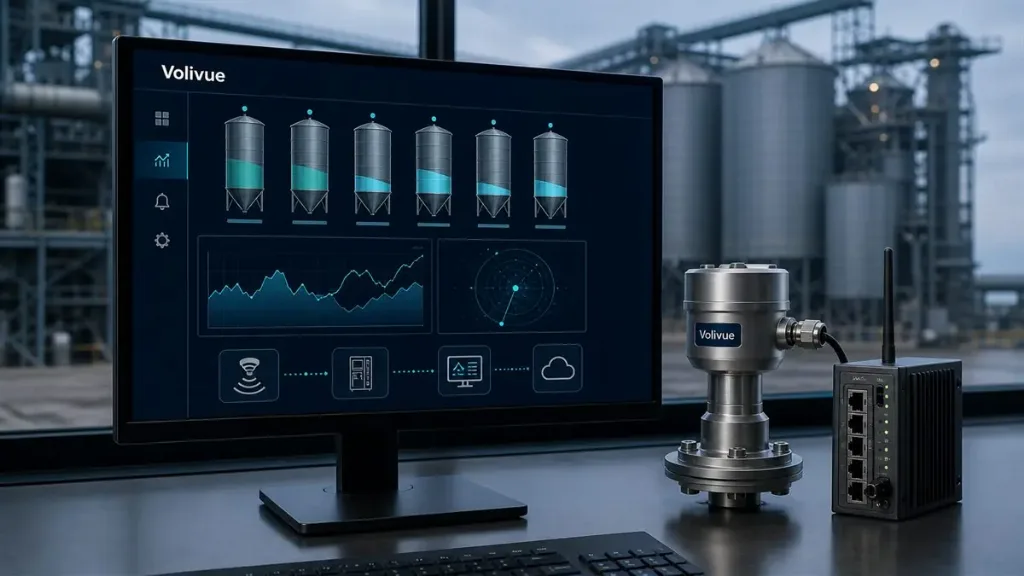
A practical fly ash silo deployment relies on a small set of capabilities rather than headline numbers. The Volivue 80GHz radar level system is a non-contact, narrow-beam FMCW instrument with measuring ranges and accuracy that are model-dependent: ranges typically span from around 0.1 m up to roughly 120 m depending on the model, and accuracy is typically quoted from a few millimetres up to a small percentage of range, again according to the model selected. For most fly ash silos, the working range comfortably covers the vessel height, and the precision is more than adequate for inventory and process control.
Integration is designed to drop into existing plant systems. The instrument supports 4–20 mA with HART, RS485 Modbus, and PROFIBUS PA outputs, so it can feed a PLC, DCS, or a standalone ash-handling controller without custom interfacing. Enclosure protection is rated to IP67/IP68, which suits the dusty, washdown-prone environment around a silo battery. Where the installation falls inside a classified area, hazardous-area variants are available according to the model; the appropriate variant should always be confirmed against the specific approval required for the site rather than assumed.
Because exact ranges, accuracy figures, and approval variants are model-dependent, the right move is to match the instrument to the silo geometry, fill method, and area classification rather than to over-specify. Conservative selection against the real duty is what produces a measurement that stays reliable for years.
Installation and Continuous Monitoring in Practice
A non-contact radar mounts on a flange or socket at the silo roof and looks straight down the vessel, which removes any need to enter the silo or work at height once it is commissioned. That single fact changes the safety profile of the whole operation: the routine of sending a technician up the silo with a tape, opening a roof hatch, and leaning over a dust-filled headspace simply goes away. The instrument should be positioned away from the fill stream and any internal obstructions so the focused beam reaches the surface cleanly, and the silo profile should be configured so the system interprets the cone and the irregular surface correctly.
Once continuous data flows into the control system, the plant gains live silo content, fill-rate trending, and high- and low-level alarming. Loading can be stopped automatically before the silo blinds, discharge crews can be dispatched against a real number, and maintenance can watch for buildup or abnormal drawdown patterns. The measurement that used to be a periodic, manual, hazardous snapshot becomes a constant, hands-off signal that the rest of the ash handling logic can be built around.
Pairing Radar With Mass for Cross-Verification
Level is the natural primary measurement for an ash silo, but it is not the only useful one. Fly ash density varies with the source coal, the combustion conditions, and how aerated the material is after pneumatic loading, so a level reading and an inventory-by-mass figure will not always tell exactly the same story. Cross-checking the two is a strong way to catch problems such as bridging, rat-holing, or a drifting sensor.
This is where same-brand patch-mount weighing becomes a useful complement. By instrumenting the silo legs or support structure to derive stored mass, the plant gets an independent measurement that can be compared against the radar level. When the two agree, confidence is high; when they diverge, that disagreement is itself a valuable diagnostic that points to a flow problem inside the vessel or to material that has not settled as expected. Level for surface position and mass for stored quantity together give a fuller, more trustworthy picture than either measurement alone.
Putting It to Work
Fly ash silos combine almost every condition that makes solids level measurement hard: ultra-fine dust, low dielectric material, violent pneumatic loading, and irregular surfaces, all in a vessel that is dangerous to climb. A focused, non-contact 80GHz radar addresses those conditions directly, delivering continuous, reliable level data that improves safety and lets the plant treat its ash inventory as a planned resource. Paired with patch-mount weighing for mass cross-verification, it forms a measurement strategy that holds up across the loading cycle and across the life of the silo. To discuss the right configuration for your silo geometry and area classification, contact the Volivue engineering team.
Related reading: explore more application guidance and measurement fundamentals in our Technical Insights library.