 EN
EN 中文
中文 ES
ES RU
RU FR
FR PT
PT AR
AR DE
DECement Silo Inventory Management: From Manual Roof Readings to Real-Time Weighing

For most cement plants, ready-mix batch plants, and fly ash terminals, cement silo inventory is still tracked the way it was decades ago: a worker climbs to the silo roof, opens a hatch, lowers a weighted tape or eyeballs the level, and writes a number on a clipboard. That single number then drives reordering, production planning, and month-end reconciliation. When the number is late, wrong, or skipped during bad weather, the cost ripples through purchasing and dispatch. This guide looks at why manual readings fall short for powdered materials, and what changes when silo contents are measured as mass in real time.
The Real Cost of Manual Roof Readings
Climbing a silo to record a level is one of the more hazardous routine tasks on a cement site. Roofs are tall, often dusty, sometimes iced over, and surrounded by moving traffic from tankers and loaders. Confined-space and fall-from-height exposure is real every time someone goes up to check a hatch. Many plants reasonably limit how often this happens, which means inventory data is only as fresh as the last climb.
That creates three compounding problems:
- Safety exposure. Every manual reading is a fall and dust-exposure event waiting to happen, and frequency cannot be increased without raising risk.
- Time lag. A reading taken once per shift, or once per day, is already stale by the time it informs a reorder decision. Continuous draw during production is invisible between readings.
- Human error. Manual estimates of a sloping, irregular powder surface are imprecise, and transcription mistakes on a clipboard or spreadsheet compound the uncertainty.
The result is a plant that is effectively running on a snapshot taken hours ago, using it to make decisions that depend on knowing the present.
Why Powdered Cement Breaks the Level-Height Method

The deeper issue is that height does not equal quantity for fine powders. Cement, fly ash, and similar materials do not behave like water in a tank. Their bulk density shifts with aeration, moisture, fineness, and how recently the silo was filled. Freshly pneumatically loaded cement is fluffed up and reads high; the same mass settled and de-aerated reads lower. A level figure converted to tonnage using a fixed density assumption can be off by a meaningful margin in either direction.
Powder behavior inside the silo makes this worse:
- Rat-holing and bridging. Material can form a stable channel or arch, so the surface a level device sees has little to do with the mass actually stored below it.
- Cone and sidewall buildup. Cement cakes on walls and forms irregular cones, so a single-point reading rarely represents the true profile.
- Dust and buildup on sensors. Heavy airborne dust during filling, plus product caking on the sensor face, degrades many level technologies over time.
This is the core distinction between the two approaches. The level-height method infers quantity from a measured surface and an assumed density. The mass-based method measures the load itself. For cement powder, where density is variable and the surface is unreliable, measuring mass sidesteps the assumptions that make height readings drift.
That said, level sensing still has a place. A non-contact 80 GHz radar such as the 80 GHz radar level sensor sees through dust well and is a sound choice for high accuracy on level, overfill protection, and as a complement to weighing. The practical point is matching the method to the question: use level when you need surface position and headroom; use mass when you need to know how many tons you actually own.
How Real-Time Weighing Works on Existing Silos

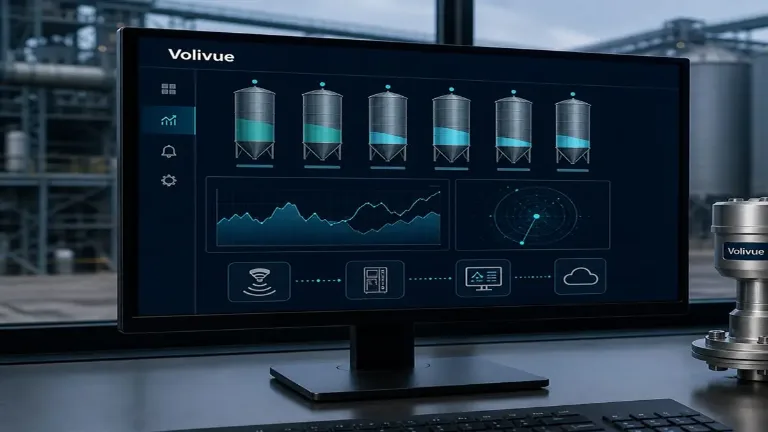
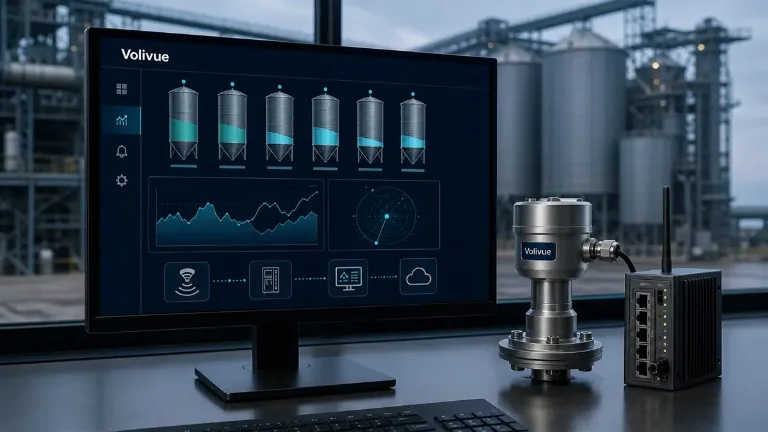
Mass-based measurement reads the load the silo structure already carries. The patch-mount silo weighing system does this by bonding strain-gauge sensors to the outside of each support leg. As the silo fills and empties, the legs deform by tiny amounts under load; the gauges read that microstrain, and an algorithm converts the combined signal into stored mass.
A few characteristics make this practical to retrofit on a working plant:
- No production stoppage. Sensors mount on the exterior of the legs, so there is no need to open the roof, empty the silo, or cut into the structure. Typical installation runs about 2–4 hours per leg.
- Scales to the silo group. Systems support roughly 2 to 12 legs and capacities that typically range from 5 up to 3,000 tons, which covers everything from a small batch-plant silo to large clinker and cement storage.
- Built for accuracy after calibration. Accuracy is typically in the range of ±0.5–3% of full scale once calibrated against the specific silo.
- Integrates with existing systems. Output is available over 4–20 mA and RS-485, with an API for software integration, and connectivity via 4G, Wi-Fi, or BLE. An IP66 rating is planned for the enclosure.
Because the measurement is mass and not height, the reading stays meaningful regardless of how fluffed, settled, bridged, or cone-shaped the material is inside.
Turning Silo Data Into Inventory Decisions

A live tonnage figure on every silo is useful on its own, but the value compounds when the data drives the surrounding workflows.
- Multi-silo coordination. With every silo in a group reporting mass continuously, operators can see at a glance which silos to draw from, balance levels across the group, and avoid running one empty while another sits full. This matters most on sites with parallel silos feeding the same product.
- Reorder and refill timing. Knowing both the current mass and the rate of draw lets a plant trigger replenishment at the right moment, rather than ordering on a fixed calendar or reacting to a near-empty silo. That smooths tanker scheduling and reduces both stockouts and overfills.
- Dispatch and production planning. Batch plants can confirm there is enough of each material before committing to a pour or a delivery window, instead of discovering a shortfall mid-shift.
- Purchasing and production reconciliation. This is where mass-based data earns its keep. Inbound deliveries are weighed at the tanker; consumption is metered at the batcher. When silo contents are also a real mass figure, the three can be reconciled. Delivered minus consumed should track the change in silo inventory. Persistent gaps point to short deliveries, metering drift, or losses that a level-only system would never surface.
The shift here is from inventory as a periodic clipboard entry to inventory as a continuous data stream that purchasing, production, and dispatch all read from the same source.
Choosing and Combining the Right Method
For most cement and fly ash storage, mass-based weighing is the stronger primary basis for inventory accounting, because it answers the commercial question directly: how many tons are in the silo, regardless of how the powder is behaving. Level sensing remains valuable for surface position, headroom, and overfill safety.
A pragmatic pattern many plants land on:
- Use exterior strain-gauge weighing as the system of record for tonnage and reconciliation.
- Use non-contact radar for level, high/low alarms, and overfill protection.
- Feed both into the same control or ERP layer so operators see one consistent inventory picture.
Combining the two means inventory accuracy no longer depends on someone climbing a silo, and the plant is not forced to choose between knowing how full a silo is and knowing how much it actually holds.
If you are evaluating a retrofit across a silo group, contact a Volivue engineer with your silo count, leg configuration, and capacities, and we can help scope an installation that fits your site without interrupting production.
Related reading
For a deeper look at how dust, bridging, and buildup affect level measurement in cement silos, and how to choose between technologies for powdered materials, see the Technical Insights for related technical articles on silo level measurement and selection.