 EN
EN 中文
中文 ES
ES RU
RU FR
FR PT
PT AR
AR DE
DERadar vs Ultrasonic for Solids Level Measurement: A Selection Guide
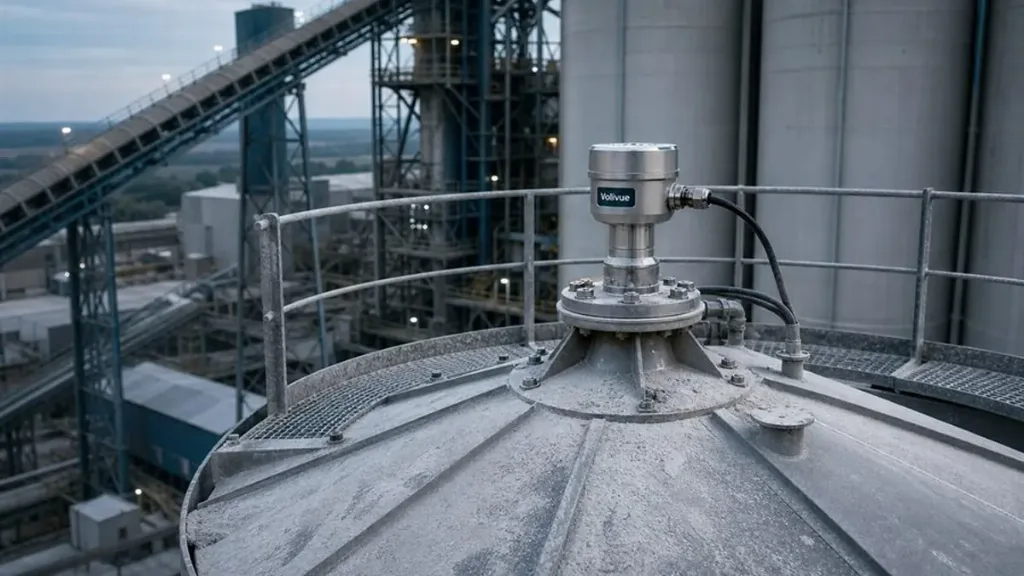
Choosing between radar and ultrasonic level technology for bulk solids comes down to one question: how forgiving is your process? This radar vs ultrasonic solids comparison weighs each principle against dust, geometry, and material. Both are non-contact methods, both are mature, and both belong in the same product family—but they earn their keep in different environments. Ultrasonic shines where the air is clean and calm. Radar holds its accuracy where dust, agitation, and tall narrow geometry would otherwise blind a sensor. This guide compares the two technologies dimension by dimension for bulk solids and powders, then offers a practical decision path so you can match the measurement principle to the bin, not the other way around.
The short version: there is no universally “better” choice. There is only the right fit for a given silo, material, and duty cycle. Below, we walk through the physics and the trade-offs so the fit becomes obvious.
How Each Technology Measures Level
Ultrasonic sensors emit a pulse of high-frequency sound from the top of the vessel and time the echo that bounces off the material surface. Distance is derived from the speed of sound through air, and level is the vessel height minus that distance. Because the method relies on a physical sound wave traveling through the headspace, anything that disturbs that medium—dust clouds, temperature gradients, vapor, or vacuum—changes how the wave propagates and can weaken or scatter the returning echo. An ultrasonic level sensor is elegant precisely because it is simple: low power draw, modest electronics, and a straightforward echo-timing principle.
80 GHz radar sensors send a continuous frequency-modulated microwave signal (FMCW) and measure level from the frequency shift of the reflected wave. Microwaves are largely indifferent to the air itself—dust, vapor, and pressure changes do not slow them down the way they affect sound. The high 80 GHz frequency produces a very narrow beam (roughly 3 degrees), which lets the signal travel down a tall, slim silo without clipping the wall, internal structures, or buildup. That focus is the defining advantage of a modern 80 GHz radar level transmitter in difficult solids service.
The core distinction is the carrier: ultrasonic carries information on a sound wave that needs a cooperative medium, while radar carries it on a microwave that does not.
Dust, Agitation, and Process Disturbance
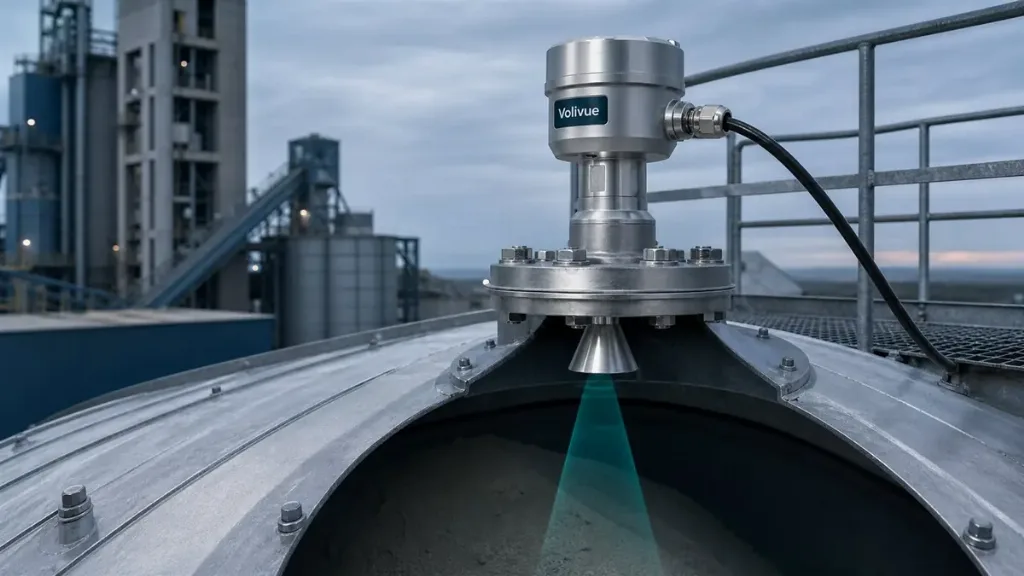
This is the single most decisive dimension for bulk solids, because filling and discharging powders is inherently messy.
When material drops into a silo, it kicks up a dust cloud and creates turbulence in the headspace. For ultrasonic, those airborne particles scatter and absorb the sound pulse; a dense dust cloud during filling can attenuate the echo to the point where the reading drifts or drops out until the air settles. Strong product flow, fluidized powder, and vacuum conditions all degrade ultrasonic performance for the same underlying reason—the sound wave’s medium is no longer well behaved.
Radar at 80 GHz is far less sensitive to these conditions. Microwaves pass through typical dust loading with little loss, so the level reading stays usable during active filling and discharge rather than waiting for the headspace to clear. For continuously cycling silos, blenders feeding from above, or pneumatic-fill operations, this stability is often the deciding factor.
Low-Dielectric Materials and Surface Reflectivity
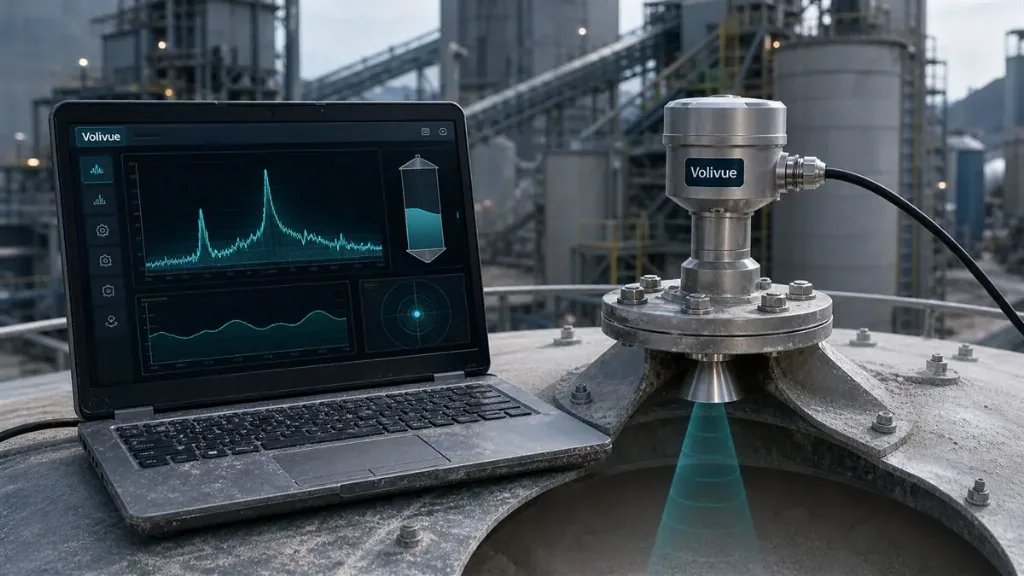
Solids reflect radar based on their dielectric constant. Many bulk solids—plastic pellets, wood chips, certain grains, and light powders—have low dielectric values and reflect a weaker microwave signal than liquids or metals. Older or lower-frequency radar could struggle here, but the tight, high-energy-density beam of 80 GHz radar concentrates its signal on the surface, improving the odds of a clean return even from poorly reflective, low-dielectric solids. Performance is still model- and material-dependent, so very low-dielectric or steeply angled surfaces warrant a sensor and antenna review.
Ultrasonic does not depend on dielectric constant at all—it only needs a surface that reflects sound. For a soft, sound-absorbing material (fluffy or very porous powders), an ultrasonic echo can be muffled, whereas a firm surface returns sound well. So neither technology is universally better on “difficult” solids; they fail for different reasons, and the failure mode should guide the choice.
Range, Geometry, and Mounting
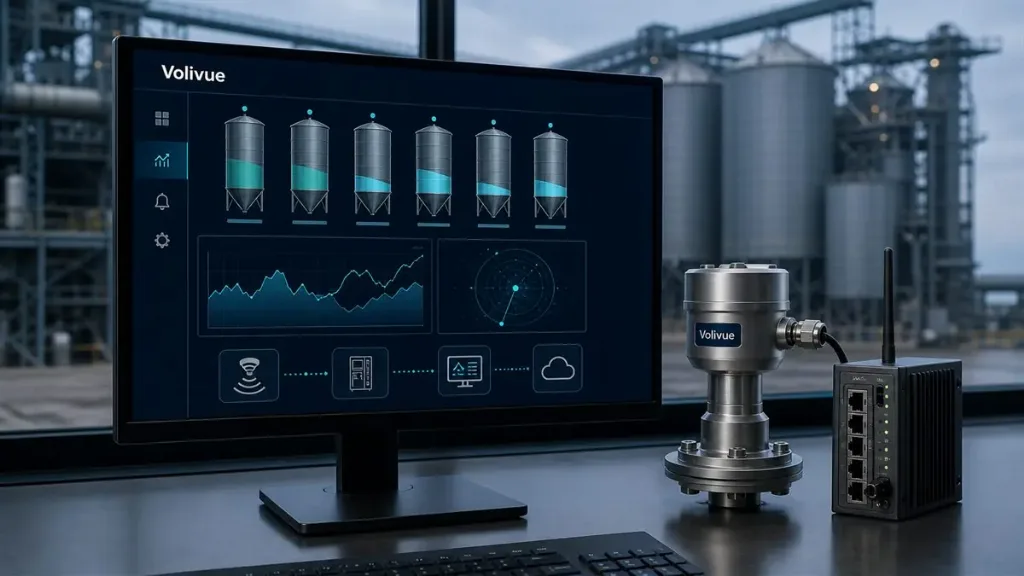
| Dimension | 80 GHz Radar | Ultrasonic |
|---|---|---|
| Measuring principle | FMCW microwave (non-contact) | Sound-wave echo (non-contact) |
| Typical range | ~0.1–120 m (model-dependent) | Shorter, model-dependent |
| Typical accuracy | ±2 mm to ±3% (model-dependent) | Coarser than radar, model-dependent |
| Beam angle | Narrow (~3°), avoids walls/structures | Wider cone, more sensitive to obstructions |
| Dust / fill-flow immunity | High | Limited; degraded by dust and turbulence |
| Vacuum / pressure tolerance | Tolerant | Sound needs air; vacuum impairs it |
| Low-dielectric solids | Workable with focused beam (model-dependent) | Unaffected by dielectric; needs reflective surface |
| Relative cost & power | Higher | Lower, low power draw |
| Best-fit duty | Dusty, tall/narrow, agitated, low-dielectric | Clean, calm, low-dust, ambient pressure |
Tall, narrow silos are where the narrow radar beam earns its premium: it travels the full height without catching the wall, weld seams, ladders, or product caked on the side. Ultrasonic’s wider cone is more likely to pick up false echoes from internal obstructions in a slim vessel, and its effective range is shorter, which can rule it out for very deep silos. For shallow, wide, uncluttered bins in clean service, ultrasonic’s range and beam pattern are perfectly adequate.
Cost, Power, and Total Practicality
On a relative basis, ultrasonic is the more economical and lower-power option. Its simpler electronics make it attractive where conditions are benign and budgets are tight—think clean granulate storage, water-treatment chemical bins, or indoor hoppers with gentle, intermittent filling. For battery or solar-powered remote sites, its modest power draw is a genuine advantage.
Radar carries a higher relative cost, justified when the process would defeat ultrasonic. Paying more for radar in a clean, calm bin is over-specifying; paying less for ultrasonic in a dusty, agitated silo is a false economy that shows up as nuisance dropouts, manual checks, and inventory uncertainty. The right lens is cost of reliable data over the equipment’s life, not the line-item price of the sensor.
How to Choose for Your Solids Application
Match the technology to the toughest condition the bin sees, not the average:
- Choose 80 GHz radar when the silo is tall and narrow, filling kicks up heavy dust, the material is agitated or pneumatically conveyed, the vessel runs under vacuum or pressure, or you need tight accuracy over a long range. It is the safer default for demanding bulk-solids duty.
- Choose ultrasonic when the vessel is clean and calm, dust during filling is minimal, the range is short to moderate, pressure is near ambient, and cost or power budget is the binding constraint.
- When in doubt, ask what happens during the worst few minutes of a fill cycle. If the headspace fills with dust or the surface churns, lean radar. If the air stays clear, ultrasonic will likely serve well at a lower cost.
Because both technologies share the same engineering pedigree, the goal is fit, not loyalty to one principle. A well-matched ultrasonic sensor in easy service is just as “correct” as radar in a punishing silo. If your application sits in the gray zone—moderately dusty, mixed materials, or variable duty—a short application review of vessel geometry, material dielectric, fill method, and accuracy target will settle it quickly. Talk to our measurement engineers with your silo details and process conditions, and we will recommend the technology and model that fit.
Related Reading
For the broader framework behind these trade-offs—how to read a datasheet, prioritize process conditions, and avoid common selection mistakes across level technologies—see our level sensing selection guides in Technical Insights.