 EN
EN 中文
中文 ES
ES RU
RU FR
FR PT
PT AR
AR DE
DESilo Weighing Integration: 4–20 mA, Modbus, and API Paths to PLC, SCADA, and ERP/MES
Silo weighing integration is the work of turning a mass measurement on a vessel into a number your control system, historian, and business software can actually trust. The sensor is only the front end. The harder engineering problem is the path: how raw load data gets sampled, calibrated, filtered, transmitted, and reconciled against the inventory records your planners already rely on. Get the path wrong and you end up with a precise scale feeding a spreadsheet nobody believes.
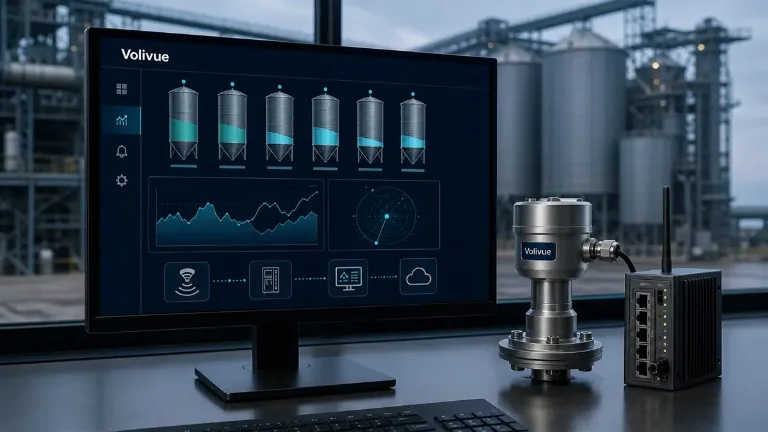
This article compares the three integration paths most commonly used with a patch-mount silo weighing system: a 4–20 mA analog signal into a PLC or DCS, an RS485 Modbus link into SCADA or local HMI/configuration software, and an API over 4G/WiFi into ERP, MES, or an IIoT platform. Each path moves the same underlying mass value, but they differ in latency, data richness, wiring effort, and how cleanly they close the loop with your inventory ledger.
The data flow behind every integration path
Before choosing a transport, it helps to fix the data flow that sits underneath all three. A patch-mount silo weighing system measures mass through strain on the silo support legs. That raw signal goes through four stages regardless of how it eventually reaches your systems:
- Acquisition. Strain is sampled and converted to a mass value. Sampling rate matters more for fast-filling vessels than for slow bulk storage.
- Calibration and filtering. The device applies its calibration so output lands within roughly ±0.5–3% FS after calibration. Filtering smooths the mechanical noise from agitators, pneumatic conveying, and material bridging or collapse, so downstream systems see a stable trend instead of a jittering raw read.
- Reporting. The conditioned value is published over the chosen interface — 4–20 mA, RS485 Modbus, or API.
- Reconciliation and alarming. The receiving system compares the live mass against expected levels, triggers low-level or anomaly alarms, and reconciles measured inventory against book stock.
The transport you pick changes how much of stages 3 and 4 happen on the device versus in your infrastructure. That is the real decision.
Path A: 4–20 mA analog into PLC or DCS
The analog path maps the full mass span to a 4–20 mA current loop wired into an analog input card on your PLC or DCS. It is the most conservative choice and still the default in many process plants.
Where it fits. Tank farms, feed silos, and any vessel already inside a PLC/DCS control scheme where the weight needs to participate in interlocks, batching, or closed-loop control. If a low-level condition must stop a screw feeder in milliseconds, analog into the PLC is the right answer.
Strengths. Deterministic and low-latency — the loop is effectively real time. It needs no protocol stack, integrates with hardware you already maintain, and current-loop signaling is robust over long cable runs and electrically noisy environments.
Trade-offs. One loop carries one variable: mass, and nothing else. There is no device diagnostics, no timestamp, no sensor health, no multi-silo addressing on a single pair of wires. Every silo needs its own analog input channel and its own cable run. Scaling and zero have to be configured correctly in the PLC, and any drift between the device span and the PLC scaling becomes a silent error.
Use this path when control performance and determinism outrank data richness.
Path B: RS485 Modbus into SCADA or local configuration software
The Modbus path puts the weighing device on an RS485 serial bus speaking Modbus RTU, polled by a SCADA server, local HMI, or configuration software. One twisted pair can address multiple devices.
Where it fits. Plants standardized on SCADA, sites with several silos in one area, and operations that want trend logging and local visualization without committing to cloud infrastructure. It is the natural middle ground between raw analog and full cloud integration.
Strengths. A single bus reads many silos, which slashes wiring versus one analog channel per vessel. Modbus registers can expose more than a single number — mass, status, and configurable parameters — so SCADA gets richer context. Polling is well understood by virtually every SCADA and HMI package, and historian logging, setpoints, and alarm thresholds live in tools your controls team already operates.
Trade-offs. Polling latency depends on bus speed, the number of devices, and poll interval — fast enough for inventory and trending, not for hard real-time interlocks. RS485 wiring discipline matters: proper termination, biasing, and daylight between the bus and VFD/motor cabling. Register maps, byte order, and scaling factors must be matched exactly between device and master, and a mismatch produces plausible-looking but wrong values.
Use this path when you want multi-silo visibility, local trending, and SCADA-native alarms without external connectivity.
Path C: API over 4G/WiFi into ERP, MES, and IIoT
The cloud path uses the device’s built-in 4G, WiFi, or Bluetooth radios to push readings via API into an ERP, MES, or IIoT platform — bypassing the control network entirely for business-layer integration.
Where it fits. Remote or unmanned silos, multi-site fleets, outdoor storage where pulling cable to a control room is impractical, and any case where the goal is to drive replenishment, purchasing, and inventory accounting rather than process control. This is where patch-mount silo weighing system data starts to move planning, not just valves.
Strengths. Readings carry timestamps and device context, land directly in the systems that own stock records, and require no new control-network cabling. A site with intermittent connectivity can still report on a schedule. The API path is what makes measured inventory drive automated reorder points, supplier callouts, and consumption analytics — turning a level reading into a procurement signal.
Trade-offs. Network dependence means you must design for dropped connectivity, retry, and buffering, and define a polling or push cadence that fits both data needs and data cost on cellular links. Cloud and API integration belong to IT as much as to controls, so security, authentication, and data ownership need agreement up front. This path is not intended for safety interlocks or sub-second control.
Use this path when the consumer of the data is your business systems, not your control loop.
Comparing the three paths
| Dimension | 4–20 mA → PLC/DCS | RS485 Modbus → SCADA | API + 4G/WiFi → ERP/MES/IIoT |
|---|---|---|---|
| Latency | Real time | Poll-rate dependent | Scheduled / near real time |
| Data richness | Mass only | Mass + status + parameters | Mass + timestamp + context |
| Multi-silo on one link | No (one channel each) | Yes (addressable bus) | Yes (per-device push) |
| Wiring effort | High (per vessel) | Moderate (shared bus) | None (wireless) |
| Primary consumer | Control / interlocks | Operations / trending | Planning / accounting |
| Best for | Closed-loop control | Local SCADA visibility | Replenishment, reorder, reconciliation |
These paths are not mutually exclusive. A common pattern uses 4–20 mA or Modbus for the control and operations layer, while the API simultaneously feeds ERP/MES for inventory accounting. The same calibrated mass value serves both audiences without forcing one team to read the other’s system.
Closing the loop: inventory, replenishment, and the “stock black hole”
The reason to integrate at all is to make stored mass act on something. Three loops matter:
Replenishment and purchasing. When measured mass crosses a reorder point, the ERP/MES path can flag a replenishment task or surface a low-stock signal to planners. Because the device reports actual mass rather than an inferred level, reorder logic reacts to what is physically in the vessel, not to a calendar assumption.
Low-level and anomaly alarms. A low-level alarm protects against starving a downstream process. An anomaly alarm — mass dropping far faster than scheduled draw, or rising when no fill was expected — flags leaks, theft, blockage, or a feed fault. Analog and Modbus paths raise these in the control room; the API path raises them to whoever owns the asset, including unmanned sites.
Reconciliation against book stock. This is where measured weight earns its keep. Every plant carries a gap between what the ERP says is in a silo and what is actually there — the “stock black hole” of consumption miscounts, density assumptions, and unrecorded movements. Feeding measured mass back for periodic reconciliation turns that gap from a quarterly surprise into a continuously monitored variance. The book figure and the measured figure can be compared on a schedule, and persistent drift becomes a data point to investigate rather than a write-off at audit.
The integration path determines who sees each loop. Control teams get interlocks over analog. Operations get trends and SCADA alarms over Modbus. Planners and finance get reorder triggers and reconciliation over the API. Designed together, the three give the same mass value a job at every layer of the plant.
Choosing your path
Pick by the consumer of the data, not by habit. If the weight drives a control decision, use 4–20 mA into the PLC. If you want multi-silo local visibility and SCADA-native alarms, use RS485 Modbus. If the goal is replenishment, purchasing, and reconciliation across one or many sites, use the API over 4G/WiFi. Most mature deployments run two paths at once, and the patch-mount approach supports all three from the same device.
To scope a path for your silos — interface selection, register mapping, alarm logic, or ERP/MES reconciliation — reach out for an application review with your vessel count, existing control platform, and target business system.
Related reading
For a deeper comparison of silo inventory methods and how measured mass stacks up against level-based estimation for closing the stock black hole, see the silo inventory accuracy guides in our Technical Insights.