 EN
EN 中文
中文 ES
ES RU
RU FR
FR PT
PT AR
AR DE
DEPatch-mount weighing for food, feed, and grain silos
Food ingredient, animal feed, and grain storage facilities need accurate consumption tracking and refill timing without adding contact sensors inside the stored material.

Confirm the site problem, the Volivue approach, and the expected operating benefit before final selection.
Internal contact measurement points raise contamination concerns, complicate cleaning procedures, and are often impractical for hygiene-sensitive or bulk organic materials such as grain, flour, or feed pellets.
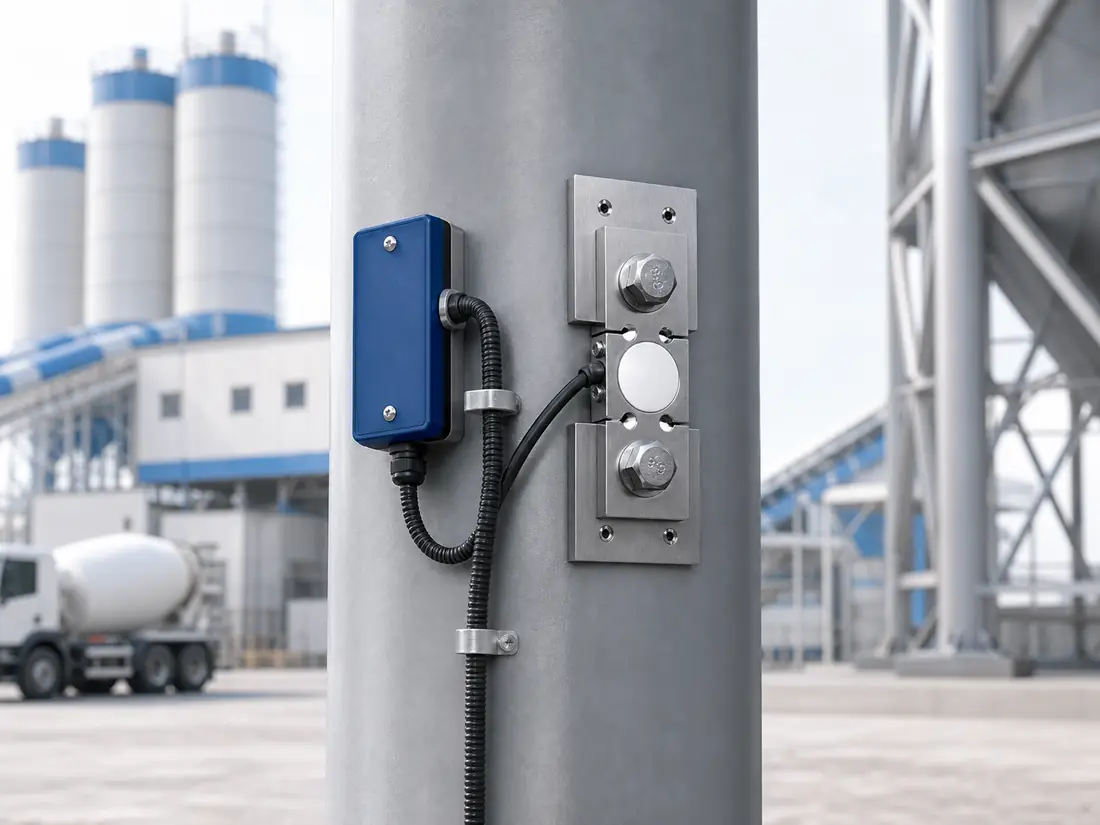
Fit external patch-mount strain sensors to silo support legs so the entire sensing layer stays outside the stored material, and connect to cloud software for real-time consumption trend, low-stock alerts, and refill scheduling.
Inventory and warehouse teams can track material consumption and plan refill cycles without entering silos or adding internal hardware, supporting hygiene requirements and simplifying maintenance.
Hygiene-first inventory: keeping every sensor outside the silo
Food ingredient, feed, and grain silos add a constraint most industrial silos do not have: nothing extra should touch the stored material. Internal probes complicate cleaning validation, create residue traps, and are unwelcome anywhere flour, grain, or feed pellets are handled. At the same time these sites depend on accurate consumption tracking, because a late refill stops a feed line just as surely as a breakdown.
Patch-mount weighing answers the hygiene constraint structurally: the strain sensors sit on the outside of the support legs, so the product-contact surfaces of the silo remain untouched. The boundary is the structure itself. Flat-bottom grain bins on concrete and skirt-supported silos have no legs to instrument, and there a Volivue radar level instrument on a roof nozzle is the appropriate route.
Refill alarms, mobile alerts, and a feed line that never starves
Installation happens entirely outside the silo with production running, so there is no opening, no entry permit, and no recontamination concern. Once calibrated, the cloud software tracks consumption trends per silo and per day; low-stock thresholds are set per material so the alarm arrives while a normal refill order can still be placed, not after the line is at risk.
Alerts reach the people who act on them: mobile notifications for warehouse and purchasing, a multi-silo dashboard with daily records for planning, and optional RS485 or 4-20mA into the feed mill automation where dosing or interlocks need the live figure. Roles are configured so each team sees its own silos without wading through the whole site.
Four checks for food and feed silo weighing
- Leg structure surveyed: steel support legs present and accessible, with coating and surface condition noted at sensor positions.
- Material density behaviour documented, including moisture-driven variation, to set expectations for the mass trend.
- Thresholds defined per silo: low-stock alarm point, refill target level, and who is notified on each.
- Dashboard roles planned: warehouse, purchasing, and production each mapped to the silos and alerts they own.
We wash down the silo area regularly. Will cleaning around the legs affect the sensors?
The sensor modules are built for outdoor industrial mounting, and routine washdown around the legs is part of the expected environment. The practical point comes during the site survey: cable routing and connector positions are planned away from direct hose lines, so cleaning crews never have to work around the instrumentation.
Grain and feed density changes with moisture. Does the tonnage estimate drift with it?
Weighing reacts the opposite way to level sensors here: the legs carry true mass, so a moisture-driven density change shows up as a real weight change rather than an error. There is no level-to-volume-to-mass conversion that silently drifts; what the trend shows is what the structure actually carries.
Installation requirements and project workflow
Silo structure check
Send clear photos of every support leg, base plate, cross brace, discharge cone, and nearby cable route before quotation.
Mounting position confirmation
Sensors are planned near the lower support-leg area. The surface should be reachable, clean, stable, and suitable for bolted or bonded mounting.
Communication and power review
Sensors, controller, built-in communication settings, software account, and output settings are prepared according to the selected scope.
Factory preparation
Sensors, controller, built-in communication settings, software account, and output settings are prepared according to the selected scope.
Installation and commissioning
A ready silo can typically be installed and brought online in 2-4 hours, depending on access, cabling, signal, and calibration data.
Calibration and remote support
Known refill, discharge, or reference inventory data is used to improve trend calculation; support covers software, alarms, and integration.
Questions before quotation
Does installation require production shutdown?
For many ready sites, basic external sensor installation can be arranged without stopping production. Final scheduling depends on access, cabling, permits, and calibration method.
Does the silo need to be empty?
Usually no. The system is installed outside the silo. Calibration can use known refill, discharge, or reference inventory data.
How many support legs can it work with?
The standard planning range is 2-12 support legs after structure review.
How is the ±0.5-3% FS accuracy achieved?
Accuracy depends on structure condition, sensor placement, stable calibration data, and algorithm setup. The quoted range is a typical planning range after calibration.
Can I view the data on phone and computer?
Yes. The system can provide mobile and desktop monitoring software with real-time level, estimated mass, trend, alarm, and reports.
Can it connect to PLC, ERP, MES, or a custom platform?
Yes. Common outputs include 4-20mA, RS485, and API. Built-in communication and software integration scope are confirmed during project review.
Let us review your silo project.
Send silo type, drawings, material behavior, monitoring points, country or region, and integration target. We will return a practical configuration suggestion and next-step list.