 EN
EN 中文
中文 ES
ES RU
RU FR
FR PT
PT AR
AR DE
DE80GHz radar level for plastic granule and pellet silos
Plastic granules and polymer pellets have smooth, reflective surfaces at close range but can absorb or scatter radar energy at larger distances, and silo geometry often includes cone bottoms, ladders, or internal bracing.
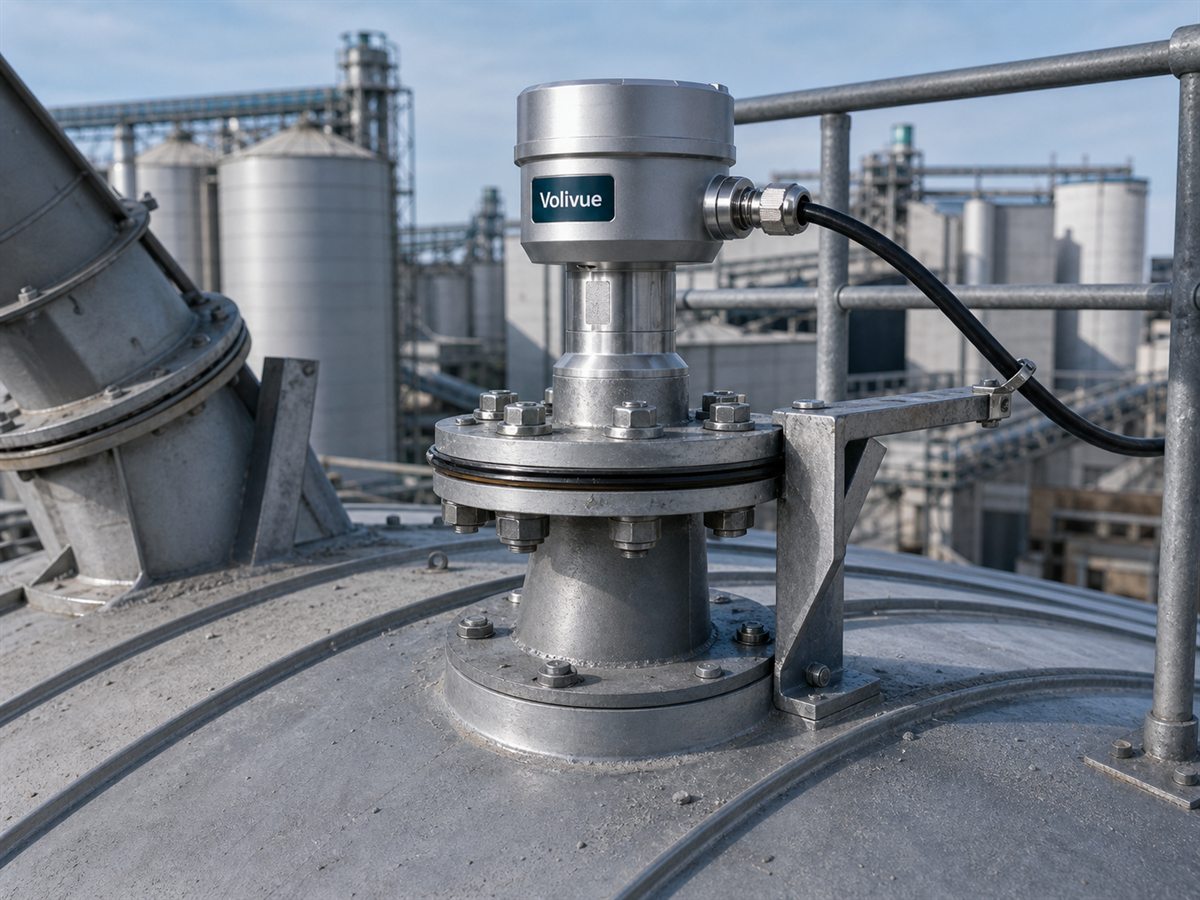
Confirm the site problem, the Volivue approach, and the expected operating benefit before final selection.
Smooth pellet surfaces and moderate dielectric constants can produce double echoes or angle-dependent reflection loss, while fixed internal obstacles like ladders and inlet tubes cause repeatable false echoes that confuse level tracking.
Select a Volivue 80GHz radar with appropriate beam angle for the silo diameter, apply false echo mapping for fixed internal structures, and verify echo stability across the full level range from empty cone to full silo top.
Continuous and trustworthy silo level data is delivered to the production planning and inventory system, reducing the need for manual stock checks and enabling automated refill threshold alerts.
Smooth pellets, internal steelwork, and echoes that need mapping
Plastic granules sit between easy and difficult: the surface reflects well at short range, but moderate dielectric constants and smooth, angled pellet slopes can bend energy away from the antenna at distance. The bigger practical problem is usually the silo itself, where ladders, fill pipes, and bracing produce repeatable false echoes that a level algorithm will lock onto if they are not mapped out.
An 80GHz radar with a beam angle matched to the silo diameter handles pellet silos well once fixed structures are mapped. The boundary case is the leg-supported pellet silo whose data consumer is ERP or production planning rather than a local level display; there the Volivue patch-mount weighing system feeds mass directly into planning software and is indifferent to pellet dielectric behaviour.
False echo mapping and a bus that scales across the silo farm
Installation aims the beam down a clear corridor: pick the nozzle farthest from ladders and fill pipes, then record a false echo map with the silo at low level so every fixed reflector is captured in one pass. Echo stability is verified across the full range, from the empty cone to the top of the highest fill, before the output is trusted.
For one or two silos a 4-20mA + HART loop into the existing PLC is simplest; for a pellet farm, RS485 Modbus lets many transmitters share a single cable run into one gateway. From there, level data can move on to MES or production planning so refill thresholds and stock alerts run on live numbers instead of shift-walk estimates.
Four checks before instrumenting a pellet silo
- Internal structures listed from the drawing: ladders, fill pipes, temperature lances, and bracing, each checked against the planned beam path.
- Beam footprint calculated at maximum distance and compared with the silo diameter and cone geometry.
- Full level range confirmed, from the cone outlet at empty to the maximum fill line, including the blind-zone margin.
- Output topology chosen: per-silo 4-20mA + HART loops, or a shared RS485 Modbus bus with addressing planned silo by silo.
Do smooth pellet surfaces really cause double echoes, and how do we see them?
They can, especially when the surface slopes toward a smooth wall: part of the energy bounces wall-to-surface and back, arriving late as a second echo. The echo curve in the setup tool shows this clearly, and correct mapping plus a beam angle suited to the silo diameter normally removes the ambiguity.
Can several pellet silos share one Modbus cable run to the control room?
Yes. RS485 Modbus is designed for that: each transmitter gets a unique address on a daisy-chained bus polled by one PLC or gateway. Plan the cable route, termination, and address list before installation so silo identities in the control system match physical silos from the first day.
Five checks that decide the radar model, mounting, commissioning, and output scope.
Collect site photos and geometry
Confirm tank or silo height, diameter, roof access, nozzle size, mounting angle, blind zone, and internal obstacles before any range claim.
Review medium and process conditions
Liquid or solid state, dielectric behavior, dust, foam, steam, oil vapor, corrosion, turbulence, agitator, temperature, and pressure determine echo reliability.
Select radar package
Choose range family, antenna or lens, process connection, seal, protection class, cable route, and accessories from the reviewed conditions.
Map usable outputs
Define 4-20mA + HART, optional RS485/Modbus, PLC, dashboard, alarm, trend, or inventory fields so the signal is useful after installation.
Commission and validate
Check scaling, false echo suppression, empty/full references, alarm points, Bluetooth setup, and trend behavior with site data.
Handover and remote support
Confirm documentation, operator training, spare parts, and a remote support path so the team can maintain scaling, echo settings, and integration after commissioning.
Selection questions for engineers, procurement teams, and site maintenance.
Is this an 80GHz radar level transmitter for both liquids and solids?
Yes. The page is positioned for liquid and solid level measurement, including tanks, silos, hoppers, and process vessels after application review.
Does the radar directly measure weight?
No. It measures distance or level. Volume or mass is calculated only when vessel geometry and density assumptions are available.
Can it handle dust, foam, steam, corrosion, and high temperature?
It can be reviewed for these harsh conditions. Suitability depends on medium, temperature, pressure, process connection, echo quality, and selected model.
What does Bluetooth commissioning solve?
Bluetooth commissioning helps review parameters, echo behavior, scaling, and diagnostics more conveniently during setup or maintenance.
Can it connect to PLC or SCADA?
Yes, the project scope can include 4-20mA + HART, optional RS485/Modbus, gateway, dashboard, or API integration.
Do you support hazardous area projects?
We can review hazardous-area requirements, but no ATEX, IECEx, SIL, or local compliance claim is made without verified product data and documentation.
What information should we send first?
Send site photos, nozzle size, medium, temperature, pressure, required output, current measurement method, and drawings if available.
What are the typical lead time and after-sales support?
Lead time depends on model, antenna, process connection, and order quantity, and is confirmed after application review. After-sales support covers documentation, commissioning guidance, spare parts, and remote help.
Send site photos, nozzle, medium, temperature, and output target.
Share tank or silo photos, medium, temperature, nozzle, dust or foam level, internal obstacles, output target, country or region, and drawings if available.