 EN
EN 中文
中文 ES
ES RU
RU FR
FR PT
PT AR
AR DE
DE80GHz radar level for fly ash and heavy-dust silos
Fly ash and other ultra-fine powders produced by combustion or industrial processes are extremely light, have low dielectric constants, and generate intense dust clouds during pneumatic filling that overwhelm many sensor types.
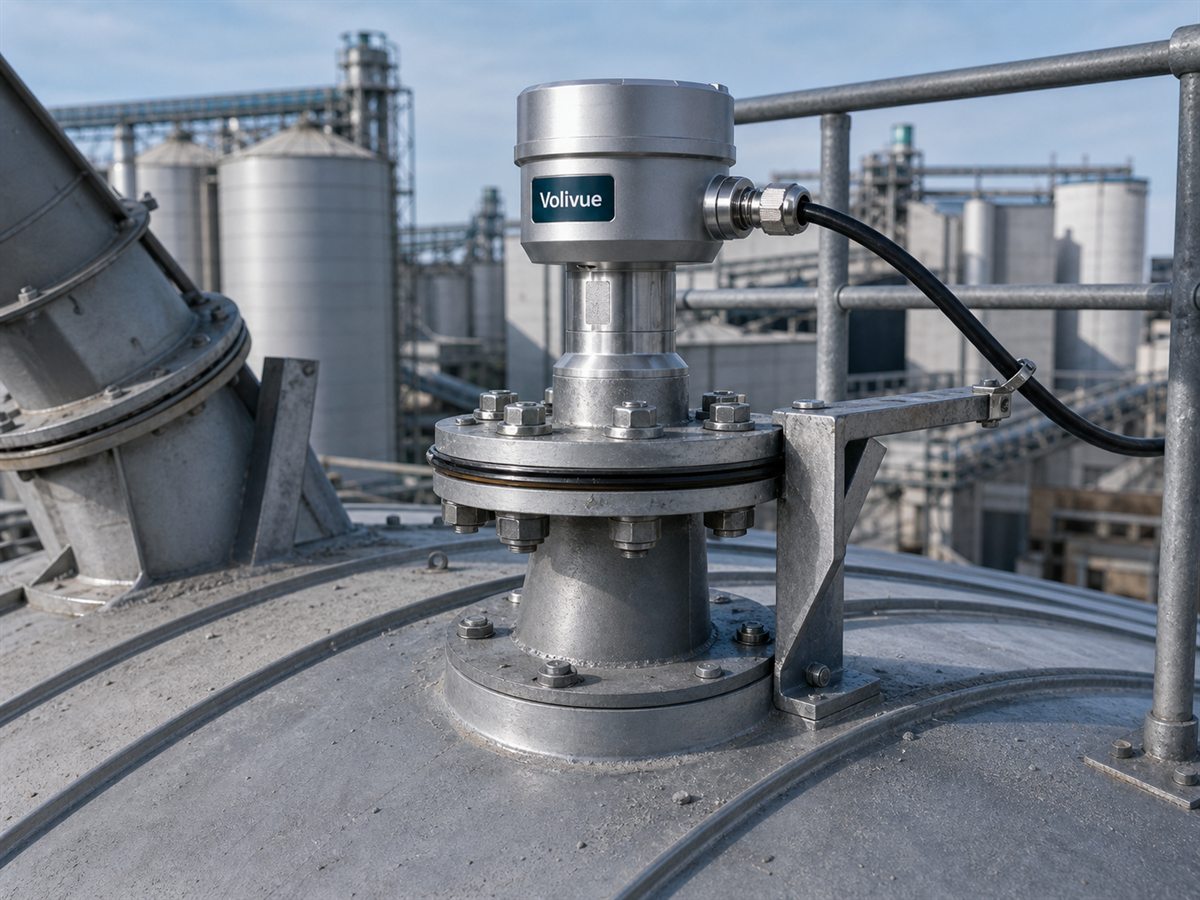
Confirm the site problem, the Volivue approach, and the expected operating benefit before final selection.
Fly ash has a low dielectric constant and ultra-fine particle size, so contact sensors, ultrasonic sensors, and lower-frequency radar devices often produce weak, intermittent echoes or frequent false-level readings in active fly ash silos.
Apply a Volivue 80GHz FMCW radar transmitter with a large lens antenna, set a suitable nozzle standoff to clear the worst dust zone, configure empty echo suppression, and review beam angle and sensitivity for the specific fly ash density and fill cycle.
Reliable level readings are maintained even during and after pneumatic filling, enabling the plant to track silo inventory without manual inspection or frequent recalibration.
Low-dielectric fly ash and the worst dust an instrument will meet
Fly ash combines nearly every difficulty a non-contact sensor can face: ultra-fine particles, very low bulk density, a low dielectric constant that returns weak echoes, and pneumatic filling that turns the whole headspace into a dust cloud for minutes at a time. Ultrasonic devices and lower-frequency radars frequently lose track in these silos, which is why fly ash is treated as its own selection case.
The Volivue answer is an 80GHz transmitter with a large lens antenna and enough nozzle standoff to clear the densest dust zone above the fill point. If the fly ash silo stands on steel support legs and the commercial question is tons on hand rather than a level profile, the Volivue patch-mount weighing system is worth comparing before a roof nozzle is fabricated.
Standoff, suppression, and proving the loop on a real fill
Deployment hinges on placement: the nozzle should sit away from the pneumatic inlet so the beam does not stare into the incoming jet, and the standoff is set so the antenna face stays above the worst dust band. Empty-silo echo suppression is recorded before first filling, and sensitivity is reviewed against the actual ash density rather than catalogue defaults.
On the signal side the transmitter offers 4-20mA with HART for a direct loop into the plant DCS or PLC, with Modbus as the multi-silo option. Commissioning should deliberately span one full pneumatic fill so filter behaviour, alarm thresholds, and the recovery time after the dust peak are all verified on record before the loop is handed to operations.
Four checks for a fly ash silo level project
- Fill path documented: pneumatic line entry point, fill rate, and the spacing between the inlet and every candidate mounting nozzle.
- Material data gathered: ash source, bulk density range, and any known tendency to bridge or compact in the cone.
- Commissioning window planned to include at least one complete pneumatic fill and the settling period that follows it.
- Interface and cable route fixed: 4-20mA + HART or Modbus, gland sizes, and the distance to the nearest marshalling cabinet.
The echo is already weak when the silo is nearly empty. Is that normal for fly ash?
Yes. A long measuring distance plus a low dielectric constant gives the weakest echo of the whole cycle at low level. The large lens antenna and empty echo suppression exist exactly for this point; if low-level readings stay unstable after tuning, the nozzle position and standoff should be reviewed rather than the gain pushed further.
Does ash coating on the antenna mean we need a scheduled cleaning routine?
The lens geometry sheds most loose dust, and a correct standoff keeps the antenna face out of the densest zone, so many sites only inspect the antenna during routine silo checks. If a site does see hard coating, that is usually a placement signal: review the nozzle position and fill-jet direction before adding cleaning hardware.
Five checks that decide the radar model, mounting, commissioning, and output scope.
Collect site photos and geometry
Confirm tank or silo height, diameter, roof access, nozzle size, mounting angle, blind zone, and internal obstacles before any range claim.
Review medium and process conditions
Liquid or solid state, dielectric behavior, dust, foam, steam, oil vapor, corrosion, turbulence, agitator, temperature, and pressure determine echo reliability.
Select radar package
Choose range family, antenna or lens, process connection, seal, protection class, cable route, and accessories from the reviewed conditions.
Map usable outputs
Define 4-20mA + HART, optional RS485/Modbus, PLC, dashboard, alarm, trend, or inventory fields so the signal is useful after installation.
Commission and validate
Check scaling, false echo suppression, empty/full references, alarm points, Bluetooth setup, and trend behavior with site data.
Handover and remote support
Confirm documentation, operator training, spare parts, and a remote support path so the team can maintain scaling, echo settings, and integration after commissioning.
Selection questions for engineers, procurement teams, and site maintenance.
Is this an 80GHz radar level transmitter for both liquids and solids?
Yes. The page is positioned for liquid and solid level measurement, including tanks, silos, hoppers, and process vessels after application review.
Does the radar directly measure weight?
No. It measures distance or level. Volume or mass is calculated only when vessel geometry and density assumptions are available.
Can it handle dust, foam, steam, corrosion, and high temperature?
It can be reviewed for these harsh conditions. Suitability depends on medium, temperature, pressure, process connection, echo quality, and selected model.
What does Bluetooth commissioning solve?
Bluetooth commissioning helps review parameters, echo behavior, scaling, and diagnostics more conveniently during setup or maintenance.
Can it connect to PLC or SCADA?
Yes, the project scope can include 4-20mA + HART, optional RS485/Modbus, gateway, dashboard, or API integration.
Do you support hazardous area projects?
We can review hazardous-area requirements, but no ATEX, IECEx, SIL, or local compliance claim is made without verified product data and documentation.
What information should we send first?
Send site photos, nozzle size, medium, temperature, pressure, required output, current measurement method, and drawings if available.
What are the typical lead time and after-sales support?
Lead time depends on model, antenna, process connection, and order quantity, and is confirmed after application review. After-sales support covers documentation, commissioning guidance, spare parts, and remote help.
Send site photos, nozzle, medium, temperature, and output target.
Share tank or silo photos, medium, temperature, nozzle, dust or foam level, internal obstacles, output target, country or region, and drawings if available.