 EN
EN 中文
中文 ES
ES RU
RU FR
FR PT
PT AR
AR DE
DEPatch-mount weighing for plastic pellet and powder silos
Plastic pellet and polymer powder producers need silo inventory connected to production scheduling, purchasing, and warehouse reporting systems with minimal downtime during installation.

Confirm the site problem, the Volivue approach, and the expected operating benefit before final selection.
Point-level switches and manual checks cannot provide the continuous inventory trend that production planning needs, and roof-mounted level sensors require silo access and may struggle with low-dielectric plastic materials.
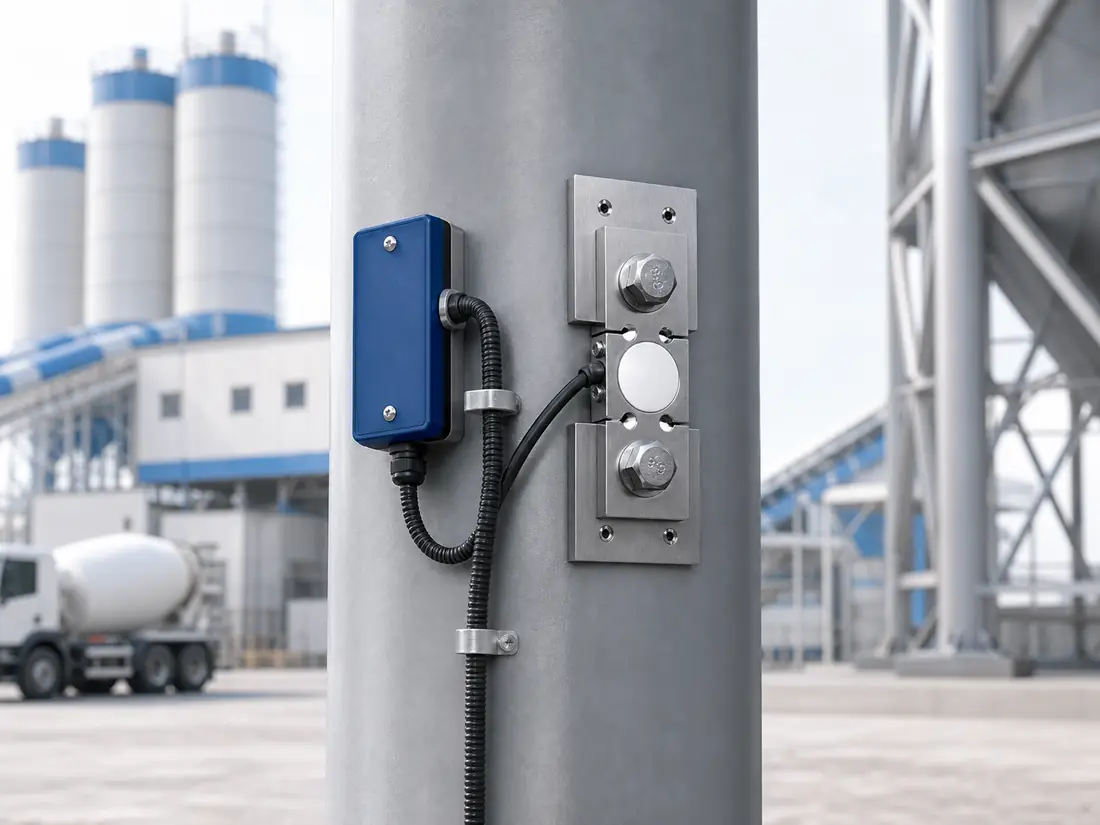
Apply external patch-mount strain sensors on support legs to continuously track estimated silo mass, and use the API or RS485 output to push inventory data directly into ERP, MES, or production planning software.
Production and procurement teams see live silo inventory in their planning software, reducing last-minute material shortfalls and enabling more accurate production batch scheduling.
Silo farms that report to ERP, not to a local display
Compounding and polymer plants typically run rows of pellet and powder silos whose inventory matters less on a local display than inside ERP, MES, and production planning. Point-level switches only say full or empty, manual rounds produce stale spreadsheets, and roof-mounted level sensors need silo access while sometimes struggling at long range on low-dielectric plastic materials.
Patch-mount weighing sidesteps the material physics entirely: strain sensors on the support legs track mass, so pellet shape, dielectric constant, and surface angle play no role. The fit requires leg-supported silos; where a silo lacks accessible legs, or a process genuinely needs the level surface rather than tonnage, a Volivue 80GHz radar with false echo mapping covers that case.

API and RS485 routes into ERP, MES, and planning software
Integration is decided before hardware ships: the cloud API pushes per-silo mass, trend, and alarm data to ERP or MES on the IT side, while RS485 serves PLC-centred plants that poll values locally. Each silo ID is mapped to a material code, so planners see resin grades and quantities rather than bare sensor channels.
Rollout across a silo farm proceeds silo by silo without stopping production, since all work is external. A practical sequence instruments one pilot group first, validates calibration against known deliveries and consumption, then extends the same template of sensor layout, addressing, and ERP mapping to the remaining rows on a fixed schedule.

Four checks before connecting pellet silos to ERP
- Per-silo structural sheet: leg count, capacity, and access, compiled for the whole farm before sequencing the rollout.
- Integration route chosen: cloud API into ERP / MES, local RS485 polling, or both in parallel.
- Silo-to-material mapping table prepared so every silo ID carries its resin or powder grade in the planning system.
- Calibration plan written around known events: weighed incoming deliveries or metered extruder consumption.
How is the system calibrated if we can never empty the silos?
Calibration works on deltas, not on an empty reference: a weighed delivery or a metered consumption gives a known mass change that the controller matches against the leg readings. Accuracy then tightens over the first few normal cycles, all while the silo keeps feeding production.
Can the inventory land in our ERP without anyone exporting files?
Yes, that is the intended mode. The cloud API delivers silo mass and trend data to the ERP or MES endpoint directly, or a PLC gateway forwards RS485 values into the plant historian. Once the silo-to-material mapping is configured, planners work from live figures with no manual step in between.
Installation requirements and project workflow
Silo structure check
Send clear photos of every support leg, base plate, cross brace, discharge cone, and nearby cable route before quotation.
Mounting position confirmation
Sensors are planned near the lower support-leg area. The surface should be reachable, clean, stable, and suitable for bolted or bonded mounting.
Communication and power review
Sensors, controller, built-in communication settings, software account, and output settings are prepared according to the selected scope.
Factory preparation
Sensors, controller, built-in communication settings, software account, and output settings are prepared according to the selected scope.
Installation and commissioning
A ready silo can typically be installed and brought online in 2-4 hours, depending on access, cabling, signal, and calibration data.
Calibration and remote support
Known refill, discharge, or reference inventory data is used to improve trend calculation; support covers software, alarms, and integration.
Questions before quotation
Does installation require production shutdown?
For many ready sites, basic external sensor installation can be arranged without stopping production. Final scheduling depends on access, cabling, permits, and calibration method.
Does the silo need to be empty?
Usually no. The system is installed outside the silo. Calibration can use known refill, discharge, or reference inventory data.
How many support legs can it work with?
The standard planning range is 2-12 support legs after structure review.
How is the ±0.5-3% FS accuracy achieved?
Accuracy depends on structure condition, sensor placement, stable calibration data, and algorithm setup. The quoted range is a typical planning range after calibration.
Can I view the data on phone and computer?
Yes. The system can provide mobile and desktop monitoring software with real-time level, estimated mass, trend, alarm, and reports.
Can it connect to PLC, ERP, MES, or a custom platform?
Yes. Common outputs include 4-20mA, RS485, and API. Built-in communication and software integration scope are confirmed during project review.
Let us review your silo project.
Send silo type, drawings, material behavior, monitoring points, country or region, and integration target. We will return a practical configuration suggestion and next-step list.