 EN
EN 中文
中文 ES
ES RU
RU FR
FR PT
PT AR
AR DE
DE80GHz radar level for cement and dry powder silos
Cement, limestone, mineral powder, and similar fine dry solids create filling streams, strong dust clouds, and material buildup on silo walls that challenge standard non-contact level sensors.
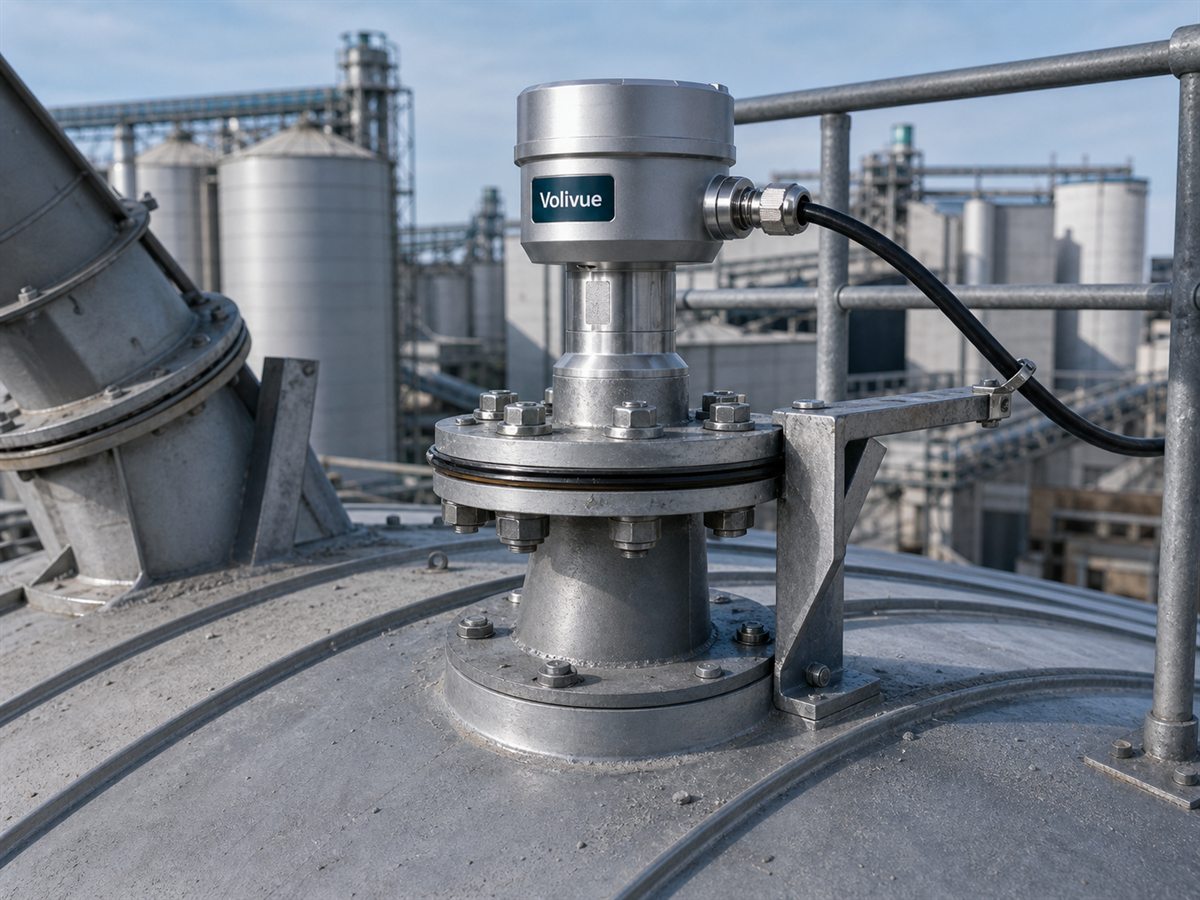
Confirm the site problem, the Volivue approach, and the expected operating benefit before final selection.
Filling streams during loading create turbulence and dust that scatter ultrasonic and lower-frequency radar echoes, causing dropouts and level jumps that make inventory decisions unreliable.
Use a Volivue 80GHz FMCW radar with narrow beam angle from the silo top, apply false echo suppression for fixed obstacles like filling inlets, and configure filtering to stabilize level output through peak filling and emptying cycles.
Level data stays continuous and stable through active filling, giving batching control, purchasing, and inventory teams reliable silo level without manual checks between cycles.
Fine dry powders, dense filling dust, and the 80GHz selection boundary
Cement, limestone, and blended mineral powders behave differently from coarse aggregates: every tanker blow-in fills the headspace with a dense dust cloud, the product surface stays loose and angled, and fine material gradually coats the silo walls and roof structure. A measurement principle for these silos must read a weak, moving surface through suspended dust without drifting as deposits build up around the mounting area.
An 80GHz FMCW radar with a narrow beam is the default Volivue choice when the silo has a usable roof nozzle and the plant needs a continuous level profile. Where a leg-supported cement or fly ash silo mainly needs inventory in tons for purchasing, the Volivue patch-mount weighing system is often the better fit, and some plants run both layers in parallel.
Roof-nozzle mounting and the path into the batching PLC
Mounting starts from the silo drawing: the transmitter sits on a top nozzle aligned vertically, kept clear of the filling stream and away from wall-side obstacles. During commissioning the team records a false echo map at low level so fixed reflectors such as the filling inlet are suppressed, then tunes filtering so the output stays steady through complete fill and discharge cycles.
The standard signal path is a loop-powered 4-20mA output with HART into the batching PLC, with RS485 Modbus available where several silos report over one bus. From the PLC the level feeds batching logic, SCADA trends, and inventory reports. A single silo is normally surveyed, mounted, and commissioned within one site visit when the nozzle and cabling are prepared in advance.
Four checks before ordering a cement silo radar
- Silo drawing on hand: nozzle positions, nozzle height and inner diameter, and the distance from the filling inlet to the planned mounting point.
- Material list confirmed: cement, limestone, or blended powders, with the worst-case dust intensity during tanker blow-in noted for antenna selection.
- Measuring range checked from the highest product level to the cone outlet, including the blind-zone margin below the nozzle.
- Signal route agreed: 4-20mA + HART into the batching PLC, or RS485 Modbus where several silos share one cable run.
Will the level reading drop out while a tanker is blowing cement into the silo?
Dust attenuates the echo but rarely removes it for an 80GHz narrow-beam radar; filtering bridges short weak-echo phases so the output trends smoothly instead of jumping. Commissioning should include at least one complete blow-in so the filter settings are proven on the real fill cycle.
Our only spare nozzle is close to the silo wall. Can it still be used?
A wall-side nozzle increases the risk that the beam clips wall buildup or the cone weld seam. Send the drawing for a beam-path review first; in many cases a slightly angled mounting or a recorded false echo map makes the position workable, otherwise a new center nozzle is the safer choice.
Five checks that decide the radar model, mounting, commissioning, and output scope.
Collect site photos and geometry
Confirm tank or silo height, diameter, roof access, nozzle size, mounting angle, blind zone, and internal obstacles before any range claim.
Review medium and process conditions
Liquid or solid state, dielectric behavior, dust, foam, steam, oil vapor, corrosion, turbulence, agitator, temperature, and pressure determine echo reliability.
Select radar package
Choose range family, antenna or lens, process connection, seal, protection class, cable route, and accessories from the reviewed conditions.
Map usable outputs
Define 4-20mA + HART, optional RS485/Modbus, PLC, dashboard, alarm, trend, or inventory fields so the signal is useful after installation.
Commission and validate
Check scaling, false echo suppression, empty/full references, alarm points, Bluetooth setup, and trend behavior with site data.
Handover and remote support
Confirm documentation, operator training, spare parts, and a remote support path so the team can maintain scaling, echo settings, and integration after commissioning.
Selection questions for engineers, procurement teams, and site maintenance.
Is this an 80GHz radar level transmitter for both liquids and solids?
Yes. The page is positioned for liquid and solid level measurement, including tanks, silos, hoppers, and process vessels after application review.
Does the radar directly measure weight?
No. It measures distance or level. Volume or mass is calculated only when vessel geometry and density assumptions are available.
Can it handle dust, foam, steam, corrosion, and high temperature?
It can be reviewed for these harsh conditions. Suitability depends on medium, temperature, pressure, process connection, echo quality, and selected model.
What does Bluetooth commissioning solve?
Bluetooth commissioning helps review parameters, echo behavior, scaling, and diagnostics more conveniently during setup or maintenance.
Can it connect to PLC or SCADA?
Yes, the project scope can include 4-20mA + HART, optional RS485/Modbus, gateway, dashboard, or API integration.
Do you support hazardous area projects?
We can review hazardous-area requirements, but no ATEX, IECEx, SIL, or local compliance claim is made without verified product data and documentation.
What information should we send first?
Send site photos, nozzle size, medium, temperature, pressure, required output, current measurement method, and drawings if available.
What are the typical lead time and after-sales support?
Lead time depends on model, antenna, process connection, and order quantity, and is confirmed after application review. After-sales support covers documentation, commissioning guidance, spare parts, and remote help.
Send site photos, nozzle, medium, temperature, and output target.
Share tank or silo photos, medium, temperature, nozzle, dust or foam level, internal obstacles, output target, country or region, and drawings if available.