 EN
EN 中文
中文 ES
ES RU
RU FR
FR PT
PT AR
AR DE
DENivel por radar de 80GHz para silos de cemento y polvo seco
El cemento, la caliza, el polvo mineral y otros sólidos secos finos similares generan corrientes de llenado, densas nubes de polvo y acumulacion de material en las paredes del silo que ponen a prueba a los sensores de nivel sin contacto convencionales.
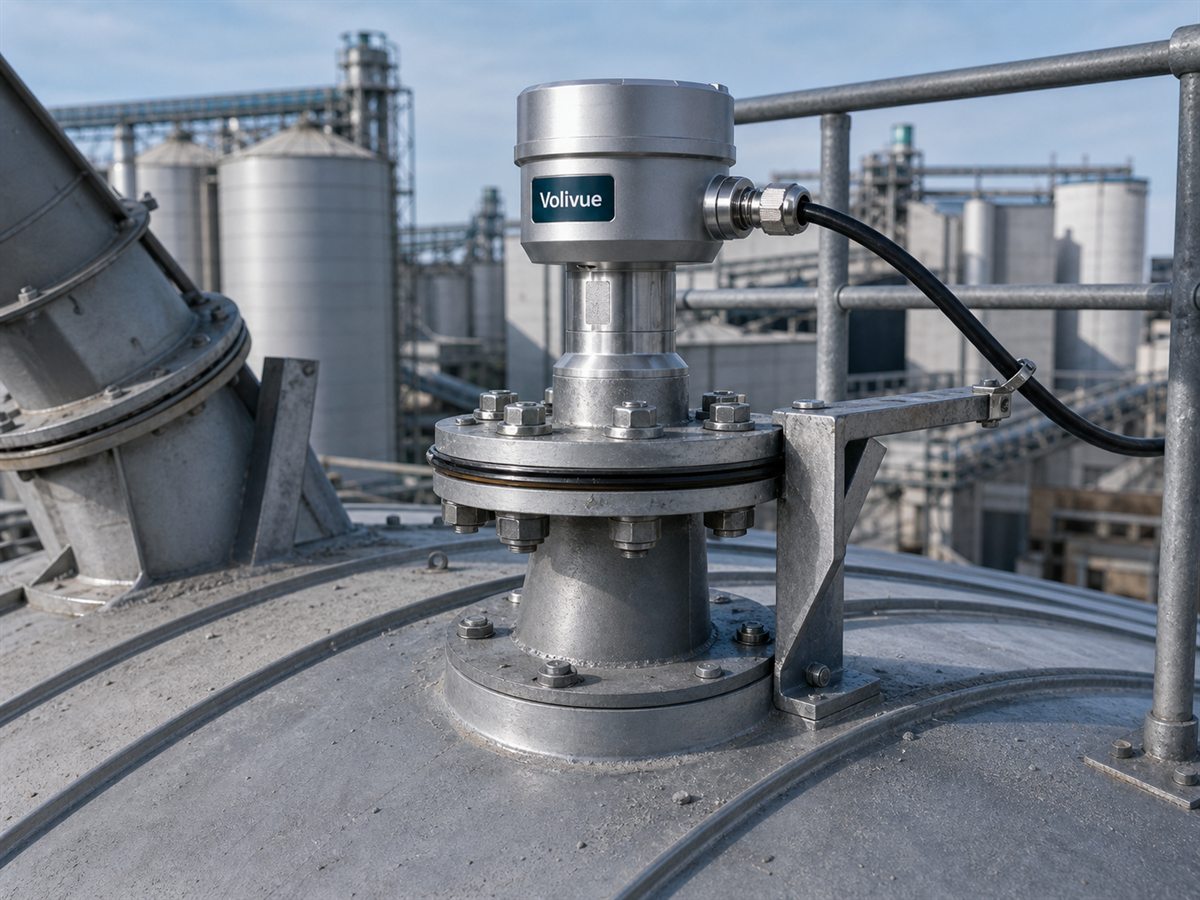
Confirme el problema del sitio, el enfoque de Volivue y el beneficio operativo esperado antes de la selección final.
Las corrientes de llenado durante la carga crean turbulencia y polvo que dispersan los ecos del ultrasonido y del radar de menor frecuencia, provocando perdidas de senal y saltos de nivel que hacen poco fiables las decisiones de inventario.
Use un radar FMCW de 80GHz de Volivue con ángulo de haz estrecho desde la parte superior del silo, aplique supresión de ecos falsos para obstaculos fijos como las entradas de llenado y configure el filtrado para estabilizar la salida de nivel durante los ciclos pico de llenado y vaciado.
Los datos de nivel se mantienen continuos y estables durante el llenado activo, ofreciendo a los equipos de control de dosificacion, compras e inventario un nivel de silo fiable sin verificaciones manuales entre ciclos.
Fine dry powders, dense filling dust, and the 80GHz selection boundary
Cement, limestone, and blended mineral powders behave differently from coarse aggregates: every tanker blow-in fills the headspace with a dense dust cloud, the product surface stays loose and angled, and fine material gradually coats the silo walls and roof structure. A measurement principle for these silos must read a weak, moving surface through suspended dust without drifting as deposits build up around the mounting area.
An 80GHz FMCW radar with a narrow beam is the default Volivue choice when the silo has a usable roof nozzle and the plant needs a continuous level profile. Where a leg-supported cement or fly ash silo mainly needs inventory in tons for purchasing, the Volivue patch-mount weighing system is often the better fit, and some plants run both layers in parallel.
Roof-nozzle mounting and the path into the batching PLC
Mounting starts from the silo drawing: the transmitter sits on a top nozzle aligned vertically, kept clear of the filling stream and away from wall-side obstacles. During commissioning the team records a false echo map at low level so fixed reflectors such as the filling inlet are suppressed, then tunes filtering so the output stays steady through complete fill and discharge cycles.
The standard signal path is a loop-powered 4-20mA output with HART into the batching PLC, with RS485 Modbus available where several silos report over one bus. From the PLC the level feeds batching logic, SCADA trends, and inventory reports. A single silo is normally surveyed, mounted, and commissioned within one site visit when the nozzle and cabling are prepared in advance.
Four checks before ordering a cement silo radar
- Silo drawing on hand: nozzle positions, nozzle height and inner diameter, and the distance from the filling inlet to the planned mounting point.
- Material list confirmed: cement, limestone, or blended powders, with the worst-case dust intensity during tanker blow-in noted for antenna selection.
- Measuring range checked from the highest product level to the cone outlet, including the blind-zone margin below the nozzle.
- Signal route agreed: 4-20mA + HART into the batching PLC, or RS485 Modbus where several silos share one cable run.
Will the level reading drop out while a tanker is blowing cement into the silo?
Dust attenuates the echo but rarely removes it for an 80GHz narrow-beam radar; filtering bridges short weak-echo phases so the output trends smoothly instead of jumping. Commissioning should include at least one complete blow-in so the filter settings are proven on the real fill cycle.
Our only spare nozzle is close to the silo wall. Can it still be used?
A wall-side nozzle increases the risk that the beam clips wall buildup or the cone weld seam. Send the drawing for a beam-path review first; in many cases a slightly angled mounting or a recorded false echo map makes the position workable, otherwise a new center nozzle is the safer choice.
Cinco revisiones que definen modelo, montaje, puesta en marcha y salidas.
Recopilar fotos y geometría
Confirmar altura, diámetro, acceso, boquilla, ángulo, zona ciega y obstáculos internos.
Revisar medio y proceso
Estado líquido o sólido, dieléctrico, polvo, espuma, vapor, corrosión, turbulencia, agitador, temperatura y presión determinan el eco.
Seleccionar paquete radar
Elegir rango, antena o lente, conexión, sello, protección, cableado y accesorios.
Mapear salidas útiles
Definir 4-20mA + HART, RS485/Modbus opcional, PLC, panel, alarmas, tendencia o inventario.
Comisionar y validar
Verificar escalado, ecos falsos, referencias vacío/lleno, alarmas, Bluetooth y tendencia con datos del sitio.
Entrega y soporte remoto
Confirmar documentación, capacitación del operador, repuestos y una vía de soporte remoto para mantener escalado, ecos e integración tras la puesta en marcha.
Preguntas que evitan mala selección y expectativas SEO incorrectas.
¿Sirve para líquidos y sólidos?
Sí. La página está posicionada para nivel en líquidos y sólidos, incluidos tanques, silos, tolvas y recipientes tras revisión.
¿Mide peso directamente?
No. Mide distancia o nivel. Volumen o masa se calcula solo con geometría y densidad disponibles.
¿Maneja polvo, espuma, vapor, corrosión y alta temperatura?
Puede revisarse para esas condiciones. Depende del medio, temperatura, presión, conexión, eco y modelo.
¿Qué resuelve Bluetooth?
Ayuda a revisar parámetros, eco, escalado y diagnóstico durante puesta en marcha o mantenimiento.
¿Conecta a PLC o SCADA?
Sí, el alcance puede incluir 4-20mA + HART, RS485/Modbus opcional, pasarela, panel o API.
¿Soporta áreas clasificadas?
Podemos revisar requisitos, pero no se declara ATEX, IECEx, SIL u otra certificación sin documentación verificada.
¿Qué información enviar primero?
Fotos del sitio, boquilla, medio, temperatura, presión, salida requerida, método actual y planos.
¿Cuáles son el plazo de entrega y el soporte posventa típicos?
El plazo depende del modelo, la antena, la conexión a proceso y la cantidad, y se confirma tras la revisión de aplicación. El soporte posventa incluye documentación, guía de puesta en marcha, repuestos y ayuda remota.
Envíe fotos, boquilla, medio, temperatura y salida requerida.
Comparta fotos, medio, temperatura, boquilla, polvo o espuma, obstáculos, salida, país y planos disponibles.